
Click below to listen to 3 easy tweaks to your homework policy:
Listen on Apple Podcasts | Listen on Spotify | Listen on Stitcher
Morning Message:
[00:56] Describe your back to school season in five words.
Everyone’s back in the swing of going back to school, so it’s time to evaluate how it’s going! Our responses are: is it the weekend yet and it started off strong, but….
We also have responses from our community, which include: way too much time involved, they will not stop talking, you don’t want to know, exhausting but improving each week, and one that pretty much sums it up is much better than last year!
The beginning of the year is hard, so however you’re feeling, make sure to give yourself some grace!
Here’s an overview of episode 31:
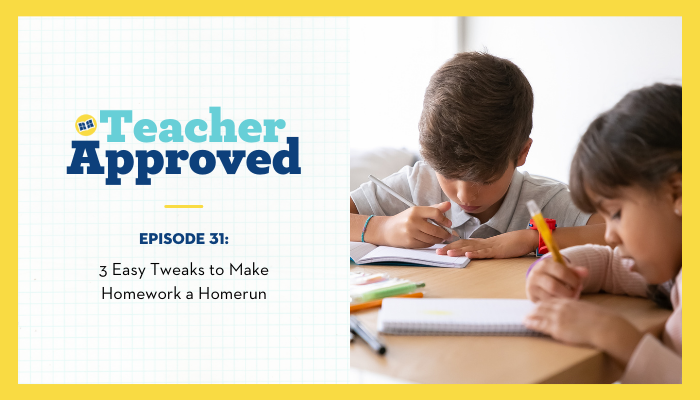
At the beginning of each year, we determine our classroom procedures and our policies around certain items. One of those policies that is up for debate each year is the homework policy. However, before determining your policy around homework, are you even going to assign homework? If you do, we’ve determined some ways to make homework a bit easier in your classroom. So in today’s episode, we’re sharing 3 easy tweaks to make homework a homerun.
While it might cause more stress, teachers are having more conversions about what actually benefits students while they’re in the classroom, rather than doing what has been done in the past. So how do we make homework benefit students? We’ve implemented three easy tweaks to homework that include making it a review, making it quick, and making it flexible.
During the episode, we share why spiral review provides consistent learning opportunities, the right amount of homework per grade level, and the importance of being sensitive to things outside of students’ control. Each of those topics revolve around our three tweaks to homework and why they benefit students.
It’s important to also be conscious about the type of assignments you’re assigning your students. One thing to keep in mind are the parent-driven or parent-involved homework assignments and being sensitive to family or outside activities students have going on. We also discuss the idea of homework being graded and what we’d do differently regarding homework in our classrooms. Trust us, we’d make some positive changes!
Back in the classroom, we never stopped to question whether or not we should be assigning homework, for we assumed it was expected because that’s all we’d known as a student. Turns out, assigning homework doesn’t have to be the norm. First, get clear on your own philosophy regarding a homework policy, then implement our three easy tweaks to make homework a homerun. By doing so, your students will hit it out of the park!
In this episode on easy tweaks to your homework policy, we discuss:
- While there’s not a lot of benefit for elementary students to complete homework, there are benefits to having students read at home
- How to appropriately make homework a review, quick, and flexible
- If we could do homework over again in our classrooms, what we would do differently
- Thinking about rebranding homework to “check your understanding questions”
- Why you should be leery of parent assignment territory
This week’s teacher approved tip:
[14:56] You can say no to assignments from parents.
While most parents think their kids are getting too much homework, there are some parents who equate homework with student excellence. Therefore, you might have parents that request more assignments for their kids to do, but does that fall on you?
Absolutely not! As teachers, we strive to provide engaging, purposeful, and relevant homework that we assign our students. Therefore, there’s no need to provide parents with extra work for their children, even if it’s requested.
Instead, get in the mindset that a parents’ problem doesn’t have to become your problem. A solution would be to put it back on the parents to provide additional engaging assignments for their child, but let them know you’re there to support them.
What we’re giving extra credit to this week:
[17:47] Heidi is giving extra credit to Resident Alien.
[18:51] Emily is giving extra credit to the air fryer.
Resources:
- 1st Grade Homework
- 2nd Grade Homework
- 3rd Grade Homework
- Building Thinking Classrooms in Mathematics
- Connect with us on Instagram @2ndstorywindow
- Shop our teacher-approved resources
- Join our Facebook group, Teacher Approved
If you enjoyed this episode, you’ll love these too:
- Episode 29, How to Be a Parent-Friendly Teacher
- Episode 25, Living in Your Season
- Episode 3, Strengthening the Brain
Read the transcript for episode 31, 3 Easy Tweaks to Make Homework a Homerun:
Hey there, thanks for joining us today. In today’s episode, we’re explaining three tweaks that can make your homework more effective, and sharing a teacher approved tip for dealing with parents.
We start our episodes with a morning message, just like we used to do at morning meeting in our classrooms. Today’s morning message is describe your back to school season so far in five words. Emily kick us off. Mine is is it the weekend yet? The pace of back to school life with my kids back in their after school activities is definitely kicking my butt. I missed them. How about you? Oh, you got a long way to go there. I know. I think mine is it started off strong but. Like I was doing really well. Maybe surprisingly well, knew that should have clued me in right that I couldn’t last. Just the last two or three weeks. I feel like I’ve been run over by like a herd of unknown, what runs in a herd, elephants, penguins, I don’t know. And I’m not even in the classroom this year. So teachers, if you feel drained, just cut yourself some slack. Because this time of year is so hard. It really is. We also have some responses from our community. Wendy said, way too much time involved. And seriously, this is a demanding season to be sure. So in our recent episode called living in your season, we talk about that. And if you’re feeling this way to go give that episode a listen, because it might help you keep some perspective in this time that feels like it’s going to last forever, but it won’t. Heather said they will not stop talking. I remember those days. Anne said you don’t want to know, no. Michelle said exhausting but improving each week. Oh, that’s good. I loved that. And Leah said exhausting, hectic, challenging fun, but overwhelming. That about sums it up. And Renee said much better than last year. Yay. I love that. We’d love to hear your response to this and other questions over in our teacher approved Facebook group or on Instagram at @2ndstorywindow and that is with a two.
This week we are diving into the wonderful controversial world of homework. If you had a meet the teacher night recently, your homework policy was probably the thing that parents were most interested in hearing about, which is understandable given how much it affects their lives. I can speak from experience here. But before you can share your homework policy, you first have to decide whether or not you’re even going to assign homework. I’ve been racking my brain trying to remember what I did for homework back when I was a baby teacher. And I am totally drawing a blank. I know a sent home spelling words and the kids were expected to read every night. I’m pretty sure that’s all I did at first. And I know you just ended up doing what I was doing when you started teaching Emily. Yeah. But I never stopped to question whether or not I should be assigning homework. I assumed it was expected because that’s all I had known as a student.
Yeah, I’m glad we’re having more of these conversations now about what actually benefits students instead of just automatically doing what we grew up with. Especially because it turns out that homework is one of those things that does deserve a closer look. In the past couple of decades, there have been lots of studies looking into the impact of homework. And they all say virtually the same thing. That elementary students don’t get much academic benefit from homework. So knowing this, did we assign homework to our students? Did we? Yes, we did. But we only assigned what we could support with research. And just so we’re clear, when we talk about homework today, we’re not talking about reading at home. There’s lots of research highlighting the benefits of reading at home. But that’s a topic that we’ll get into another day. Today we’re focusing on the idea of homework as an academic assignment that is completed outside of regular class time.
So how do we make those academic assignments completed outside of class time benefit our students? That’s a mouthful. We followed three guidelines. Make it review, make it quick, make it flexible. Emily, why don’t you kick us off on how to make homework review? Well, you know, we love review, especially spiral review. If you’re not familiar spiral review means giving students repeated exposure to content they’ve previously learned. The more we review something, the more solid our understanding of it becomes. When we do spiral review, we’re creating a safety net that helps keep information and understanding accessible in our students brains, which is what we want, right? And if you want to learn more about spiral review, which we support, check out episode three of our podcast where we dive into lots of detail about the research and why review matters. And you know, we’re serious about review, if we’ve made it the third episode of our podcast. It really does benefit kids so much, we want to provide consistent opportunities for review. And homework is a consistent assignment. So using homework as a review, is just a natural fit. And because the content is familiar, kids aren’t frustrated or confused, when they sit down to do it, they should be able to do it mostly independently. Also, limiting homework to familiar content, helps address some of the equity issues, because not every student has parents who are able to sit down and help them with their assignments each night. So we have to be careful that we’re not penalizing kids for situations they can’t control. Yes. But then we get to the question of how much spiral review to assign too much of anything, even a good thing like spiral review practice is going to cause more harm than good. It is hard for my review loving heart to believe that there is a cap on how much you’ve used you mentioned. But I guess it has to be true. I know there’s a rough guideline of about 10 minutes of homework per grade level. So that would be 10 minutes in first 20 minutes in second grade up to 60 minutes in sixth grade. You know, someone just made that up. So I think I’m just gonna make up my version. And I wonder if it should be five minutes of homework per grade level. I just don’t think 11 year olds need an hour of homework at night. I never taught upper grades. So take that into account. But that feels excessive. Yeah, having recently had a sixth grader, I completely agree that that feels excessive to me. I think I would have really been overwhelmed as a kid knowing I was facing an hour of homework waiting for me each night. No kidding.
And for our second graders, we really tried to keep our assignments quick. So for a week of homework, we assigned three half sheets of practice with math review on one side and language arts on the other. And then each week, we sent home a fluency story. The kids read the story each day, answered a question, and then did a one minute timed reading. Because research shows that repeated readings with feedback from an adult provides the best growth in fluent reading. And we also sent home weekly spelling practice because that was one thing parents were really concerned about. They wanted the routine new words on Monday test on Friday. Yes, parents are very interested in spelling, if you haven’t discovered that already, or at least they used to be maybe it’s less so these days, because some of my kids teachers have not assigned to spelling I’ve been so surprised. So that is an interesting twist. And we sent home physical copies of the assignments. I know there’s a lot of practice that you can do online. But, you know, we can’t assume that every child has access to the internet, we need to make sure we’re sensitive to issues of accessibility, which is why it’s so important to be flexible about homework. Should we be holding elementary students accountable for what happens at home when it’s largely outside of their control? That’s one thing that I would do differently now if I were back teaching second grade, I feel like I assigned a reasonable amount of homework. It was enough to enhance their learning and also give parents a sense of how well their child understood the material. But it didn’t require much time or energy to complete. So I do feel like I hit the right balance there. But if I could do it again, I would send the whole week’s assignments at once instead of a little every night. At the time. I thought daily homework was the right idea to help kids learn responsibility. But now that I have a better understanding of how busy families are, I would give them some flexibility. And honestly, I don’t know that I would count it as part of their grades. I didn’t actually correct each page because I do not believe in grading things if at all possible. But I did keep track of who turned in their papers and who didn’t. I hope It wasn’t a tyrant about it. I was always open to families not doing the homework. I told them upfront that it wasn’t worth stressing over if it was a point of contention or if they were really busy. And if they decided that homework didn’t fit with how they wanted to spend their time as a family to just let me know. But for the kids that just didn’t turn in their assignments accounted against them. And instead, I, I wish I would have just given everyone a pass. I’m sure you’re fine. There’s probably not more than five or six of them that were permanently scarred by this. Oh, no. Well, I will pay for any of my students homework related therapy.
But that does raise the question about whether or not homework should be graded. Peter Liliadoll has a chapter about homework in his book, Building Thinking Classrooms in Mathematics. And I think a lot of what he says could apply to any subject. He stopped referring to homework as homework, or as any kind of practice. Instead, he called it check your understanding questions, and made it completely optional. He found that rebranding it that way made more kids actually do the assignment. And then he used some class time to discuss how they completed the problems. So the kids could see if they actually did understand the concept. I love this idea. And given that there are so many demands on people’s time, it does make a lot of sense to find ways to approach homework from a more flexible angle. I came across one suggestion recently that instead of assigned homework questions, students are expected to complete one hour of personalized learning a week. That allows students to find something that interests them, or to practice an area where they need some more support. And that leaves the timing of it totally up to them. One thing we need to be careful of is not straying into parent assignment territory. In a recent episode, we talked about how to be a parent friendly teacher, and not assigning projects to parents is a big part of that. I frequently see these homework or reading calendars that include daily learning activities that frankly, I would consider to be a real pain in the neck. There’s not enough time between my kids getting home and the sun setting for us to walk around the neighborhood looking for things that start with the letter B. If you really want us to do something, please make it easy to check off, because I can plan my own activities with my kids without my teacher giving us assignments. Yeah, I came across a list of suggestions for ways that were supposedly making homework more applicable to real life. And the suggested activities were things like tracking sports scores, or helping with grocery shopping. And I think parents would resent that even more than a boring worksheet. Mm hmm. Yep. If you want to make these real world assignments, they definitely need to be optional. And they need to be clearly optional. So parents don’t have that sense of my kids teacher is going to judge me if we don’t visit our town’s historical site. Yes, we can only take flexible assignments so far.
And a lot of your options might be limited by your school’s policies. If your admin or your district office isn’t open to adjusting their policies, maybe you have to get creative in how you interpret those policies. Right? Maybe you have to assign homework, but do you have to grade it? Or maybe they can choose five of the questions on the page to answer. If you can’t change the system, make the system expand for you. The best way to do that is to get clear on your own philosophy of homework. We’ve given you lots of ideas today. But what makes the most sense for you and the students you teach. We mentioned three guidelines at the beginning. Make it review, make it quick, make it flexible, you will know you’re meeting your students needs and their parents needs, if your homework plans address these three areas. And if you do want to send some appropriate homework, but don’t want to create your own materials, we do offer homework in our shop. We wanted to create a homework option for teachers to use that actually meets these guidelines we’ve discussed. All of our homework is meant to be review, it’s meant to be quick, and it’s meant to be flexible. We have spiral review pages for first, second and third grades and fourth will be coming soon. And we have leveled fluency passages through fourth grade that we find perfect to send home for parents. We also have some fun spelling homework if you use chunk spelling and want some activities to send home for that. We would love to hear your new homework philosophy. Come share it in our teacher approved Facebook group.
Now let’s talk about this week’s teacher approved tip. Each week we leave you with a small actionable tip that you can apply in your classroom today. This week’s teacher approved tip is you can say no to assignments from parents. Tell us about this, Heidi. So a lot of parents equate homework with student excellence. And so some might feel like a reasonable amount of homework is not enough homework. And when I was a sweet young teacher, so naive, I used to send extra assignments when the parents would request it. I have a very clear memory of a Saturday afternoon spent in the workroom. And this was before TPT because I’m old. So I was combing through my few teacher books, trying to find something appropriately challenging that wasn’t just busy work. But I eventually I stopped doing that. I realized that I was already doing my job by sending home practice that was engaging, purposeful and relevant. Just because a parent had a request didn’t mean I had to make it my problem. And is that how you phrased it at meet the teacher? Of course not, I actually I didn’t bring it up, unless a parent approached me about it. And then I turned it right back on them. I remember, the first time I realized a parent’s problem didn’t have to become my problem. It was kind of an aha moment. I had a mom that year who felt like I should be sending home a higher volume of work for her twins. And I just put it right back on her. I said something like, that sounds like a great idea. Why don’t you take some time and figure out what would be a good project for them. And then let me know how I can support you. I’m happy to give some class time, if they have a presentation they want to give to the class. Or if they design a math game that they want the kids to play, you just let me know. And she never brought it up again. Imagine that. So after that, putting it back on the parents was my go to response for any parents wanting me to create something special for their kid. And I never had a single parent get back to me about their students outside projects. And just so we’re clear, you don’t mean kids who need extra support or a more personalized approach to assignments? No, I am happy to offer accommodations or support for kids who need a different kind of practice. I just saved this for situations when parents insisted that their kids needed more work just for the sake of having more work. And this goes to show that no matter how much or how little homework you assign, not all parents will be happy with it. That is just the nature of the game with homework. That’s why it’s important for teachers to develop their own philosophies of homework. If you can back up what you do and why you do it, you won’t find yourself taking on more work just because someone else thinks that you should.
To wrap up the show we’re sharing what we’re giving extra credit to this week. Heidi, what are you giving extra credit to this week? I am giving extra credit to the TV show Resident Alien on Sci Fi. Season two just wrapped up. And it’s such a fun show. It’s not really a science fiction series. It’s that that’s not my go to. It’s more about a quirky small town who happened to have an alien for a doctor. And that alien doctor happened to learn everything he knows from binge watching Law and Order. So there are a few holes in his understanding. All of the characters are just really well developed. And the storylines are clever. And I can’t get enough of the alien doctors feud with a nine year old boy. And I have yet to convince Emily to watch it. So if you decide to watch it, or if you’ve already watched it, please come to our Facebook group so we can chat about it. Well, I’ve just finished all of this shows that I’ve had on my to watch list recently. So maybe I’ll have to give this one a try. Yeah, let me know you have to I think you have to give it like three episodes because the first two think they’re still getting the rhythm but by the third one. Emily what’s your extra credit this week? This is the weirdest extra credit I’ve done in a while but I’m giving extra credit to air fryer. I just love that it’s so easy for my 12 year old to use when she wants to prepare something for herself which she’s starting to want to make herself little nice snacks or meals. And also we’ve been experimenting with different things you can make in it. We recently tried making s’mores with it and they turned out surprisingly well that’s interesting. I highly recommend a Ritz marshmallow Reese’s combo if you want to give this a try in your air fryer.
That’s it for today’s episode. Try tweaking your homework to make it review, make it quick, and make it flexible. And don’t forget today’s teacher approved tip to say no to assignments from other people.
More About Teacher Approved:
Do you ever feel like there’s just not enough time in the day to be the kind of teacher you really want to be? The Teacher Approved podcast is here to help you learn how to elevate what matters and simplify the rest. Join co-hosts Emily and Heidi of Second Story Window each week as they share research-based and teacher-approved strategies you can count on to make your teaching more efficient and effective than ever before.