
Click below to hear our classroom behavior management strategies:
Listen on Apple Podcasts | Listen on Spotify | Listen on Other Apps
Overview of episode 292:
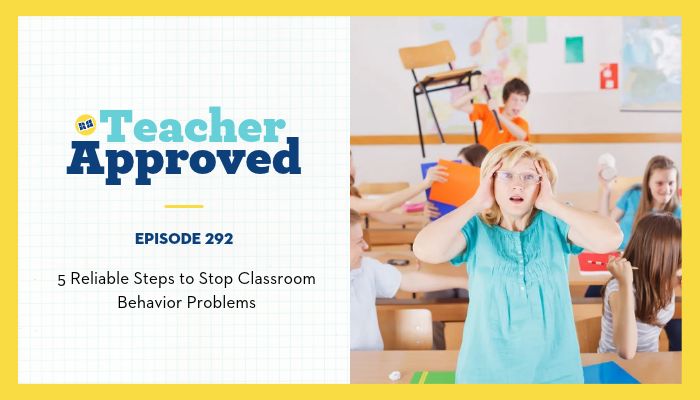
When classroom behavior starts to slide, it’s easy to feel like you have two choices: ignore it and hope it stops, or stop everything and shut it down. But what if there’s a better way? In this episode, we’re talking about our four-step behavior response ladder and how to respond to off-task behavior while keeping learning moving. We’re breaking down how to stay calm, protect your authority, and give students opportunities to get back on track before things have to escalate.
We’re walking through the small but powerful moves that can make a big difference, from “The Look” to neutral cues and proximity. We also dig into what to do when those strategies aren’t enough and a more direct correction is needed. The goal is to keep the situation from turning into a power struggle while still making it clear that expectations matter.
We also explore consequences that actually teach instead of punish, why predictability matters, and how to create consequences students can understand and expect. And when the same behavior keeps happening with the same student, we talk about why it’s time to look beyond the immediate behavior and bring in more support. Correction isn’t about punishment. It’s about giving students the support they need to make better choices.
Highlights from the episode:
[00:49] Try It Tomorrow: Set up an appreciation station
[03:48] Our four-step behavior response ladder
[05:17] Showing The Look and staying neutral to make expectations clear
[09:00] Using proximity and direct correction to redirect behavior
[11:21] Knowing when to intervene to give students more support
[18:52] Today’s teacher-approved tip for having students help draft classroom consequences
[20:27] What we’re giving extra credit to this week
Resources:
- Trashie Take Back Bags
- Card Shuffler
- Order our book: Structure and Spark
- Join The Teacher Approved Club
- Connect with us on Instagram @2ndstorywindow
- Shop our teacher-approved resources
- Join our Teacher Approved Facebook group
- Leave a review on Apple Podcasts!
- Leave a comment or rating on Spotify
If you enjoyed this episode, you’ll love these too:
- Episode 102. Classroom Behavior Problems: How to Plan Ahead to Handle Them Effectively
- Episode 164. Why You Need a Classroom Carpet and How to Manage Student Behavior
- Episode 282. 3 Ways to Hold Students Accountable to Your Classroom Expectations
- Episode 285. Positive Classroom Culture is Your Management Secret Weapon
- Episode 290. How to Read the Room When Student Behavior Feels Off
Read the transcript for episode 292:
Heidi 0:01
This is episode 292 of Teacher Approved.
Heidi 0:06
You’re listening to Teacher Approved, the podcast helping educators elevate what matters and simplify the rest. I’m Heidi.
Emily 0:14
And I’m Emily. We’re the creators behind Second Story Window, where we give research-based and teacher-approved strategies that make teaching less stressful and more effective. You can check out the show notes and resources from each episode at secondstorywindow.net.
Heidi 0:29
We’re so glad you’re tuning in today. Let’s get to the show.
Emily 0:37
Hey there! Thanks for joining us today. In today’s episode, we are sharing some quick ways to resolve classroom behavior problems, and we’ve got a teacher-approved tip for how to make your consequences more meaningful.
Heidi 0:49
But first, let’s start with a try-it tomorrow, where we share a quick win that you can try in your classroom right away. Emily, what is our suggestion for this week?
Emily 0:57
This week, try setting up an appreciation station in your classroom, so just set aside a spot in your room where students can write quick notes to classmates or staff members that they’re thankful for.
Heidi 1:08
Oh, that is the perfect idea. As we are moving into November soon, but one thing I learned from having a mailbox in my classroom: you probably want to read the notes before they get delivered. That way, nothing unexpected or hurtful gets passed along.
Emily 1:24
Yeah, you got to act as the postmaster general here. If you like this idea or anything else we share here on the podcast, would you take a second give us a five star rating and review in your podcast player?
Heidi 1:36
Well, can you believe that we are closing in on the end of October? If your students are celebrating Halloween this week, just know we are wishing you lots of patience and lots of caffeine.
Emily 1:48
And at our school, it’s also Red Ribbon Week with daily dress-up days. And even though I’m the PTA president, I’m not responsible for that decision. So I’m sorry to the teachers for that one.
Heidi 1:58
Oh dang!
Emily 1:59
But it’s already so hard to teach this week because it feels like it’s just like a classroom full of puppies. No matter what, even if you don’t have a week of dress up days, so we will just give a sigh of relief that Halloween falls on a Saturday this year.
Heidi 2:12
As it always should.
Emily 2:15
I agree. Why don’t we do that?
Heidi 2:16
Who knows?
Emily 2:17
But this is the time of year we call the season of settling in. Well, it will be for just a little bit longer. This is when the kids are feeling right at home, and when kids feel comfortable, they do our least favorite thing, which is test boundaries. It is supremely annoying and often frustrating, but that is just how kids roll, unfortunately. But luckily, it is predictable.
Heidi 2:40
Yeah, we need an off switch on that particular feature. So, if it is helpful, you can try reframing any pushback that you’re getting as a normal developmental pattern. Kids learn what’s acceptable and what’s not acceptable by pushing the limits that you set at the start of the school year. If the limit holds, they stop testing it, but if the limit collapses, they are compelled to keep pushing until they find a firmer boundary.
Emily 3:07
I was just discussing this with my fifth grader because she was talking about how the class was so crazy for this sub they had, and it was a mom from the neighborhood. And my daughter said, “I think she just didn’t want to be mean, but I don’t know why the kids were acting that way. They know they shouldn’t,” and I was like, because they’re trying to find out what the boundaries are with this sub, and they’ll keep trying until they find one.
Heidi 3:28
Yes, the worst.
Emily 3:29
But even if you know that’s what the students are doing, it can be a little hard to appreciate that fact in the moment because at 2:30 on a Friday afternoon, you don’t really care about developmental theory. You just want the talking to stop so that you can end the week in peace. So, Heidi, what strategies can help us in that moment?
Heidi 3:48
Well, that is exactly what we’re going to talk about today. I bet nobody saw that coming, and we have got a four-step framework that you can apply anytime things start sliding off track. We kind of think of this as a ladder. You start with the first intervention, and then you move up rung by rung as needed.
Emily 4:06
And luckily, the first step is often enough to solve most problems. So let’s see what that looks like in action. So tell us about it.
Heidi 4:14
Well, I wish I could do a Sophia Petrillo impression, but I just want you to picture it. You’re not in Sicily. You’re in the middle of a lesson. Most of the class is focused, but two students in the back are whispering. The whisperers are not really bothering anyone, but they’re also not listening.
Emily 4:32
So one option is just ignoring it, and maybe it will stop on its own, or maybe the talking will spread, social contagion, and there’s no way to know which one it’s going to be.
Heidi 4:42
Or you could go the other way. Stop mid lesson, call out the behavior, and announce that those two talkers will be missing recess this afternoon.
Emily 4:51
When you’re in this moment, you might be thinking that your goal is to get the kids to stop talking, but that’s actually only half of it. The goal is to get the kids to stop talking so that learning can continue.
Heidi 5:02
And those two extremes that we shared, ignoring the problem and then shutting everything down to confront it, will both inhibit that learning goal. So let’s not do that. Instead, we’re going to step onto the first rung in our ladder and try The Look.
Emily 5:17
And we talk about this in our book. And if you have our book, you know that when we say The Look, we have turned it into a proper noun, The Look.
Heidi 5:28
And that’s because the look is so elegant and yet so effective. It deserves to have some respect put on its name. So if you’re not familiar, the look is that steady eye contact that says, “I see you, you know I see you, and this is your chance to do better.”
Emily 5:44
The teacher look is probably something you are already doing because I think we just come as teachers pre-programmed to know that we need to do that. But maybe we can elevate your technique with a few tweaks because actually Heidi and I are experts at the look. So the big secret of an effective look is remaining completely impassive while delivering it. The second a student sees that they’ve aggravated you, they’ve gained control of the moment.
Heidi 6:08
And at that point, your only option is to escalate your response, which is exactly what we’re trying to avoid. So, the second you clock the whispering kids, the first thing to do is take a slow, deep breath.
Emily 6:19
And then check your body language. You want to be standing tall, relax your jaw, and let your arms hang naturally. Slowly turn to face the students in question. And in the book, we say to channel your inner Queen Victoria, Beyonce, or Fred Rogers.
Heidi 6:39
And yes, we know that that is silly, but I found it so helpful when I’m trying to channel another person’s persona in a moment that I could get a little heated. This helps me focus on my actions instead of unleashing my frustration on the children.
Emily 6:52
Yeah, so you got to do whatever it takes to maintain that calm. Once you’re facing the intended recipients of the look, hold eye contact for a full six seconds. Mentally count Mississippi’s if it helps. We are not counting Mississippilessly. Include the Mississippi’s.
Heidi 7:08
And remember that the look is not a glare and it’s not a stare down. A stare down invites a power struggle. Do you think Beyoncé gets involved in power struggles?
Emily 7:18
No, definitely not. She’s always in control. So you really just want to keep your face completely neutral. You are so unbothered, but you’re serious. But make sure you don’t have raised eyebrows, don’t chin gesture, don’t purse your lips. The more stoic you are, the more authority the look carries.
Heidi 7:39
And at that point, if the kids stop, you’re done, and you can just get back to the lesson. It took what six seconds, but if a chat about the behavior is needed, you can do that later in private.
Emily 7:50
Now, let’s say you give the look, and they’re so deep in their conversation that they never even notice. Then it’s time to move up a step on the ladder to the second rung, which is the neutral cue.
Heidi 8:01
This is a calm statement that you make to the class in general. You’re not calling out the kids in particular. So you might say something like, “Let’s do a quick check and make sure everyone is still in learning position. That means you’re sitting up straight, your mouth is quiet, and your eyes are up here.
Emily 8:16
Or you can use a cue that doesn’t mention the behavior at all and just redirects the energy. So you could say, let’s take five seconds to stretch and shake out our arms and hands. I’ll count down from five, and when I get to zero, I need everyone looking up here.
Heidi 8:30
And just like with the look, when giving a neutral cue, we are just stuffing that annoyance way down inside and radiating regal calm. The goal is to send the message that here’s the expectation, and I’m giving you a chance to meet it.
Emily 8:45
Going back to our chatty kids, let’s say the look didn’t work, but the neutral cue did work, at least for one of the two whisperers. The other one, annoyed that her buddy stopped talking, starts tapping her pencil on the desk. In that case, you need to get closer to the problem.
Heidi 9:00
And we we do mean that literally. The third rung in our behavior response ladder is proximity. So without stopping the lesson, you’re going to start moving slowly toward that student.
Emily 9:12
Because as we are fond of saying, proximity to the teacher is the best deterrent to off task behavior. And since this particular student is too far from you to be influenced by your greatness, your job is to bring your influence to them.
Heidi 9:26
And now, moving around while you teach is a good idea, even when nobody is misbehaving. That little bit of movement creates novelty, and novelty cues the brain to keep paying attention to what’s happening.
Emily 9:37
Plus, it makes sure that everyone is spending more time close to you, which helpfully curtails any misbehaviors that might be secretly brewing.
Heidi 9:45
Okay, now we’ve reached the point where the look didn’t work, the neutral cue didn’t work, and proximity didn’t work. We are getting pretty high on that ladder, and this is where direct correction comes in.
Emily 9:56
And this doesn’t mean that the first three steps failed. It’s just the point. Where a student is showing you they don’t have the skills to handle what they’re dealing with right now, and they need more support.
Heidi 10:05
So let’s swing back to that pencil tapper. What are your options now? Well, you could silently offer the tapper a quiet fidget, but this only works if you’ve already taught that student to use a fidget as a tool instead of a toy.
Emily 10:19
Yeah, let’s not make the situation even worse by giving the student something even more distracting. Another option is a direct correction.
Heidi 10:29
That’s the part that often threw me off as a teacher, because now we’ve gone from playing checkers to playing chess. Once you engage directly with the student, you’re throwing open the door to a potential power struggle.
Emily 10:42
And no one wants that. So, a good policy is to always make your opening gambit a question. Asking a question helps the student maintain some autonomy, so it lowers defensiveness. So, you might address the behavior specifically and ask, Are you able to stop your tapping, or do you need my help?
Heidi 10:58
Or you could try a more general question that you can use with almost any behavior, something like What do you think I’m going to ask you to do? is a great one to have in your back pocket.
Emily 11:08
In the whole scope of management concerns, being off task is the most common issue, even if it doesn’t always feel like that. And these four steps will cover most of what you see, probably something like 85 to 95% of your problems.
Heidi 11:21
But that still leaves you with five to 15% to deal with, and that is where our next step comes in. That is to give consequences that teach instead of punish. When the four steps on that response ladder don’t work, it’s time for the teacher to intervene.
Emily 11:37
And that shouldn’t sound like a threat. We’re not bringing down the hammer of justice, but just like we would intervene if a student were doing a math problem incorrectly, it’s appropriate to step in when students show that they aren’t able to make appropriate decisions right now.
Heidi 11:51
So, with that pencil tapper, you’ve tried the look, a neutral cue, proximity, and you’ve asked the student what she should be doing, but that pencil’s still tapping away. What would you do next, Emily?
Emily 12:03
Well, this is the point where you state what’s about to happen if you don’t see a change. It might sound like this: Ava, your pencil tapping is making it hard for others to learn. If you choose not to keep your pencil under control, I will have to hold on to it until it’s time to work, or you’ll have to move to the desk at the back so you won’t keep others from learning.
Heidi 12:19
And then comes the part that everyone hates. If the behavior continues, you have to follow through with the consequence. Otherwise, students learn that you don’t really mean what you say.
Emily 12:29
Yeah, then it’s just a threat instead of a consequence. So you need to be careful to only choose consequences that you are willing to enforce.
Heidi 12:38
Yeah, don’t punish yourself with their consequences. When I taught second grade, my go-to was moving the student. If someone was causing a problem at their desk, they moved to the back table. If we were on the carpet, they moved back to their seat. My signal was to point at the student and then point where I wanted them to go. I taught this like a procedure at the start of the year, so I talked about it and modeled it. Then everyone got a turn to be moved to a new spot for a few seconds, and then we had a discussion about why this is helpful for our class.
Emily 13:08
And I think this is really key because if you try and implement this for the first time and you haven’t ever taught it to your class, it’s probably likely to cause a lot more commotion. But if they’re familiar with the routine, I think it will be a pretty smooth, quiet process. So, think about the kinds of consequences that you can live with, moving students, or something else that you’re willing to follow through on.
Heidi 13:29
Just makes sure that your consequence isn’t taking away recess. Kids who don’t get that chance to blow off some steam often behave worse later in the day, not better.
Emily 13:39
And don’t feel bad if you’ve taken away recess in the past, because we definitely have back when that was just the expected thing to do, and now we know better. When you know better, you do better.
Heidi 13:48
I do have regrets about that.
Emily 13:50
You also want to avoid taking away specialty classes. For some kids, PE or art is the one time of the day that they feel successful, and losing it can make them resentful instead of teachable.
Heidi 14:02
I did have one exception to that, though. If the poor behavior happened in the specialty class, I thought it was logical for the student to miss that class the next time, and then spend that time reflecting on the choices they got them there. So I would have them, you know, write an apology to that specialty teacher, explaining what they will be doing better next time. My thinking is that specialty teachers have a hard enough job, and my students are not going to be making it any harder.
Emily 14:30
Yeah, I agree. And in this case, I think you are doing such a service for that teacher because I think it’s a lot harder to have good classroom management when you only see these kids once a week, and then you see all the other kids too. So the least we can do is help them enforce some boundaries by not sending the naughty kids back week after week without any consequences.
Heidi 14:49
Yes, and I did get the sense from some of the specialty teachers that other teachers didn’t have that same philosophy, so they did appreciate that I was willing to help them manage.
Emily 14:58
So if you can’t take away recess and you can’t take away specialty classes, what can you take away? Think about the preferred activities in your room, like being the line leader, choosing flexible seating, or getting technology time. You can say, “If you’re not doing your work, you’re showing me you’re not responsible enough to handle this today.”
Heidi 15:16
And if none of those options work for your class, a helpful little trick is to build in 5 to 10 minutes of free time at the end of the school day. You can offer the class some choices that you can live with, like coloring, reading, or games, and then you have that little bit of time to chat with any students who need to make a plan for what they can do better tomorrow.
Emily 15:36
And those steps, our response ladder, and the logical consequence work great. And in a perfect world, they would have a 100% success rate.
Heidi 15:44
But as we know, kids often have different opinions about how things should run. So, what do you do when you give the look or your neutral cue, and the kid says, “I wasn’t even doing anything.”
Emily 15:55
And the stakes here can feel so high because this showdown is likely unfolding with an eager little audience, you might worry that if you lose this moment, you lose them all.
Heidi 16:05
But remember that you only lose if you get pulled into a power struggle. So don’t take the bait. You actually don’t have to prove anything. The student knows what they were doing. They’re just trying to deflect. So ignore that little attempt to turn a consequence into a conversation.
Emily 16:21
And then work up a one-on-one version of the ladder of responses. Start with a six-second look. Keep your face completely neutral, even if your mind is racing. If the student is still not changing course, slowly move closer if you’re not already nearby.
Heidi 16:35
And then we’re going to restate the expectation and the consequence if it’s ignored. During work time, voices should be off. If you choose to keep talking, you will be moved to the table, so you won’t distract other students.
Emily 16:47
And now the bonus step that we didn’t mention, which is an important one: give the student some space. Say, I’ll give you a minute to decide, and then walk away.
Heidi 16:54
If they get on task, perfect. Leave it alone for now. You can talk about it later in a calmer moment, but that walking away lets the student save face, which can be a huge help in diffusing any big feelings that might erupt.
Emily 17:08
You also want to walk away if the student completely shuts down. Trying to solve a problem with a kid who feels under attack will only make things worse.
Heidi 17:15
But if you have a student who escalates to threats or violence, just stop everything and get the front office involved. Some students have needs that go beyond what these four steps can address.
Emily 17:26
Right. You should always remember on our podcast when we’re talking about classroom management strategies, we’re sharing the strategies that will work for most students most of the time. This framework is for responding to a behavior in the moment. It is not a fix for larger unmet needs. If you’re repeatedly giving consequences to the same student, that’s a sign that you need to figure out what’s really going on.
Heidi 17:48
This is where documentation matters. Yes, it’s a hassle, but it’s the only way to get that student any real help. Write down what you’re seeing, what you’ve tried, and what happened, and of course date it. And then when you call home or you go to the principal, you can show that you’ve already tried everything that they’re about to suggest to you, and it’s time that they bring in some real support.
Emily 18:09
And if you’re worried your principal won’t back you up, documentation is even more important. If things get more serious, nobody can say you weren’t doing enough.
Heidi 18:17
But hopefully, fingers crossed, everyone, that you do not have too many of those cases to deal with, and for all the little stuff, you know exactly what to do. Start with the look and move your way up the ladder.
Emily 18:27
When students know you mean what you say and that you respond fairly, they learn they can count on you. Correction isn’t about punishment; it’s about giving students the support they need to be successful.
Heidi 18:38
If this discussion gave you some things to think about, you will be happy to know we cover all of this and much, much more in our new book, Structure and Spark: A Flexible Framework for Every Classroom Curveball. You can grab it anywhere that you can buy books online.
Emily 18:52
Now for our teacher-approved tip of the week, where we share an actionable tip to help you elevate what matters and simplify the rest. This week’s teacher-approved tip is to have your students help draft your classroom consequences. So tell us more about it, Heidi.
Heidi 19:06
Well, this one just seems like a perfect fit for our discussion today. So to do this with your class, start by talking about how far everyone has already come this year. Name the great things that you’ve seen, and then we’re going to just pivot to some problems that also have started to crop up.
Emily 19:21
And be sure to keep this general, so no students feel like they’re being ganged up on.
Heidi 19:25
Oh yeah, you might want to try something like, “I’ve noticed some talking during work time, and it’s making it harder for us to focus and learn. And then ask students what consequences would be appropriate for problems that keep us from learning, and then just write down what they say on a chart or on that slide.
Emily 19:41
The funny thing is that the kids will definitely be much harder than you would be.
Heidi 19:46
Yeah, for some reason they jump straight to going to the principal or whatever your behavior management system at the school is. So you know, walk them back to the gentler consequences first, and then you can build from there. Make sure that every consequence you adopt is practical, appropriate, and something that you’re actually willing to enforce.
Emily 20:06
And then, when a problem pops up, you are not making it up on the spot. You can say we agreed on these consequences together, which is much harder for kids to argue with. And also, if you all agreed together, then they also know what to expect. They know what’s coming if they don’t start with the lowest intervention and stop their behavior.
Heidi 20:24
Yes, the predictability makes a big difference.
Heidi 20:27
To wrap up the show, we are sharing what we’re giving extra credit to this week. Emily, what gets your extra credit?
Emily 20:33
I am giving extra credit to our automatic card shuffler. So, Heidi and I, I’m sure we’ve mentioned this before, have arthritic thumbs, which is the most embarrassing thing to say when you’re 40, or younger in Heidi’s case. Well, I probably knew I was younger too. I just didn’t know what it was when I was younger. I just thought that’s how thumbs feel.
Heidi 20:57
Yeah, I was going to doctors for this in my 20s and getting misdiagnosed for lots of years.
Emily 21:02
Yeah. So one of the bummers of the way your thumbs hurt when your your CMC joint that joint right at the bottom of your thumb doesn’t work right is that a lot of normal things you do with your hands, like gripping, really cause a lot of pain. And I used to be a really good card shuffler, so it bums me out to say that shuffling cards is very painful for me now. I have a hard time keeping a good grip on it with my thumbs being so messed up, and then it hurts.
Emily 21:29
And so I decided to invest in an automatic card shuffler. You just split the deck into the two little trays on the side, and then they push a little button, and then it super fast combines them into the middle already shuffled, and of course we end up doing it like four or five times because everyone wants a chance to do it because it’s so fun. It’s especially nice when you have big decks that like take a long time to get well shuffled and integrated with each other. It’s just handy to have. I mean, even if you don’t have broken thumbs like us, I think it’s just super handy to have if you like playing card games, which we do at my house.
Heidi 22:03
Well, that’s perfect. I want one just to play with.
Emily 22:06
You should. It’s practically a fidget toy. What are you giving extra credit to, Heidi?
Heidi 22:12
Well, I’m giving extra credit to Trashie bags, and Emily, I know you’re already familiar with this.
Emily 22:16
I sure am.
Heidi 22:17
How this works is you buy these like giant, how big are they? They’re like, they’re big, like three foot bags that come to your house, and then you fill them with all of the fabric items that you don’t want. You know the clothes. I should have looked up the list before I started talking.
Emily 22:34
I think you can do like towels.
Heidi 22:36
Anything that’s not soiled. I think they said so nothing with stains.
Emily 22:41
But it can have like holes and things like that.
Heidi 22:44
They just ask that it be washed. Because my go-to used to be just sending it to the thrift store, but a lot of stuff doesn’t get resold because it’s too beat up. So then it just ends up in landfills, which, as we know, is a problem because we all have so many clothes. So this way, so they promise that nothing will end up in the landfill. If they can’t give it to a thrift shop, they’ll find a way to recycle it or give it a new life somehow. So that is why it’s worth it to me for the cost of the bags. So you just load it up, and then you get a like a barcode to scan. Unfortunately, you do have to take it somewhere to send it in, but then it’s out of your house and you’re all done. And I one thing I like about it is when I’m setting aside stuff that I would give to the thrift store, it just kind of is another pile of my house. But here it goes right in the bag, and then I can just move it along.
Emily 23:28
Oh yeah, that’s such a good point. And I used to have things that I would feel really guilty about, of like, well, I don’t really want to send this to the thrift store because they probably won’t want it because it’s beat up. But then throwing it away just made me feel gross, so I really appreciate having this option with Trashie Bags to be able to send anything fabric as long as it’s not gross and get it out of your house guilt free. And I’ll just add in that if you know you’re going to be going through like all your kids’ bins of clothes that you’ve saved or your whole closet, then it’s definitely worth it to sign up for the Trashie Unlimited because you get a year and you can send as many bags as you want, and that is pretty affordable. But oftentimes they have deals on it, so I have had that this year, which has made it a lot easier to just be sending lots of stuff away from my house.
Heidi 24:16
Yeah, I’m going to drop mine in the mail tomorrow, so.
Emily 24:19
I’ll send mine with you.
Heidi 24:20
Well, that is it for today’s episode. When kids get off task, start with the look and work your way up the ladder of responses. And don’t forget to get the kids involved in drafting your class consequences.
Emily 24:34
If this is the kind of thing you want help with, it’s what we do inside the Teacher Approved Club. We offer guidance and resources to help you navigate each season of the school year, and we’re headed into the holiday ramp up. So we are ready to support you there in the Teacher Approved Club. You can check it out at secondstorywindow.net/club.
Heidi 24:52
We hope you enjoyed this episode of Teacher Approved. I’m Heidi.
Emily 24:56
And I’m Emily. Thank you for listening. Be sure to follow or subscribe in your podcast app, so that you never miss an episode.
Heidi 25:03
You can connect with us and other teachers in the Teacher Approved Facebook group. We’ll see you here next week. Bye for now.
Emily 25:09
Bye.
More About Teacher Approved:
Do you ever feel like there’s just not enough time in the day to be the kind of teacher you really want to be? The Teacher Approved podcast is here to help you learn how to elevate what matters and simplify the rest. Join co-hosts Emily and Heidi of Second Story Window each week as they share research-based and teacher-approved strategies you can count on to make your teaching more efficient and effective than ever before.