
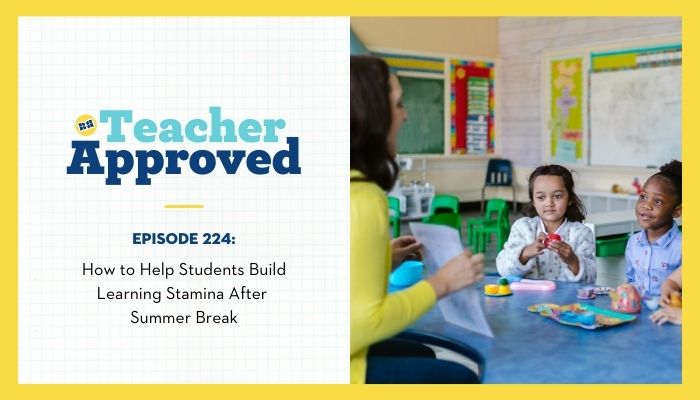
Click below to hear 5 tips for building learning stamina:
Listen on Apple Podcasts | Listen on Spotify | Listen on Other Apps
Overview of episode 224:
Have you ever launched into a beautifully planned lesson only to watch your students’ focus vanish within minutes? We’ve all been there – the endless pencil sharpening, bathroom requests, and wandering eyes that make it clear our kids aren’t quite ready for sustained independent work. In this episode, we’re diving into building learning stamina, including why it matters, how to treat it as a skill, and the simple steps you can use to help students strengthen their ability to stick with challenging tasks. Just like we don’t expect students to multiply two-digit numbers without instruction, we can’t expect them to focus for long stretches without intentionally teaching and growing this capacity!
We share a favorite classroom story that highlights how powerful it can be to start small and celebrate every bit of progress in the process of building learning stamina. With just a timer, some intentional reflection, and a little creativity, you can transform focus into a fun class challenge instead of a dreaded task. The best part? The exact strategies that help kids read for longer stretches also work for writing time, math practice, centers, and even smoother morning routines.
Throughout the episode, we break down five key takeaways to guide you in building learning stamina with your students. From giving them the language to understand what stamina means, to making progress visible, to using strategic breaks and goal setting, these strategies will help your students move beyond short bursts of attention and build lasting stamina. By the end, you’ll see that stamina isn’t something students either have or don’t have. It’s a skill that can be taught, nurtured, and celebrated in every classroom!
Highlights from the episode:
[00:49] Try it Tomorrow: Narrate positive things you see while kids are working (make it about the effort, NOT the outcome!)
[04:06] How we’ve built reading stamina with second graders at the beginning of the year
[08:47] Five key steps to building learning stamina in any subject
[20:18] Today’s teacher-approved tip for elevating your sub plans
[21:29] What we’re giving extra credit to this week
Resources:
- Back-to-School Brain Breaks
- Kindle Page Turner Remote
- Visible – Save $20 with our link!
- Connect with us on Instagram @2ndstorywindow.
- Shop our teacher-approved resources.
- Join our Teacher Approved Facebook group.
- Leave a review on Apple Podcasts!
If you enjoyed this episode, you’ll love these too:
- Episode 98, 5 Reasons Your Attention Signal Isn’t Working and How to Improve It
- Episode 164, Why You Need a Classroom Carpet And How to Manage Student Behavior
- Episode 191, Get Moving! Simple Movement Hacks That Save Your Sanity AND Boost Learning
- Episode 223, The Core 4 Routines Every Classroom Needs to Run Like Clockwork
Read the transcript for episode 224:
Heidi 0:00
This is episode 224 of Teacher Approved.
Heidi 0:06
You’re listening to teacher approved, the podcast helping educators elevate what matters and simplify the rest. I’m Heidi.
Emily 0:14
And I’m Emily. We’re the creators behind Second Story Window, where we give research based and teacher approved strategies that make teaching less stressful and more effective. You can check out the show notes and resources from each episode at secondstorywindow.net.
Heidi 0:28
We’re so glad you’re tuning in today. Let’s get to the show.
Emily 0:36
Hey there. Thanks for joining us today. In today’s episode, we’re talking about how to help your students build their learning stamina, plus we’ve got a teacher approved tip for elevating your sub plans.
Heidi 0:49
But first, our try it tomorrow. Emily, what is our quick win for this week?
Emily 0:53
Okay, so tomorrow, when kids are working, try narrating positive things that you see, but make it about the effort, not the outcome. So instead of, ‘you’re doing great,’ try saying, ‘I see someone trying two different ways to figure out that problem to make sure they got the same answer.’ This takes two seconds, but it shows everyone what you value, and encourages them to keep working hard.
Heidi 1:18
This seems so minor, but it’s a really powerful shift. Kids need to know what good work actually looks like.
Emily 1:25
If you like this idea or anything else we share here on the podcast, would you take a second and give us a five star rating and review in your podcast listening app?
Heidi 1:34
All right, imagine it’s the second week of school. You’ve planned a beautiful, independent writing lesson, you’ve explained the directions clearly, modeled what good work looks like, and confidently sent your students off to write. And I bet you can guess what happens next.
Emily 1:51
Well, let me think, probably about three minutes in, half the class is at the pencil sharpener, two kids are done with work already that should have taken them 20 minutes, and someone’s having a sudden shoe emergency that apparently cannot wait.
Heidi 2:06
Exactly. If you have ever asked your students to work independently for 15 minutes in those first days of school, you know exactly what we’re talking about, the wandering eyes, the bathroom requests, and suddenly everyone’s water bottle is desperately empty.
Emily 2:23
Yes, and it’s not that your students don’t want to focus. It’s just that many of them are still in summer brain mode. So their attention spans are shorter. They’re adjusting to new routines and expectations, and they’re just not used to sustained focus anymore.
Heidi 2:39
And that is assuming that they ever had the skills to focus to begin with. But rather than pushing through hoping it will get better, what if we took a more proactive approach? What if we treated stamina not as something kids either have or don’t have, but as a skill we can teach and grow, just like reading or math.
Emily 2:58
We don’t expect kids to multiply two digit numbers without teaching them how, right? So why do we sometimes expect them to focus for extended periods without explicitly building that capacity? And that’s exactly what we’re going to talk about today. And Heidi, kick us off. You’ve got a good example of this, right?
Heidi 3:17
I do. Well I hope everyone is comfy, because we are starting with a story time, and I so wish right now that I could do a Sofia Petrillo impression, but you’re just gonna have to imagine me with gray curls and a wicker purse.
Emily 3:32
Picture it. And if you’re too young to get that reference, first of all, how dare you. And we probably seem so old to you right now that you do think we have gray hair and wicker purses.
Heidi 3:44
So rude.
Emily 3:46
I mean, the gray hair may be accurate. It’s not fully gray though, we are taking care of that, but I do not have a wicker purse, thank you very much.
Heidi 3:56
Although, is it bad if I say I saw one the other day online, and I thought, Oh, that’s cute.
Emily 4:01
Oh, shoot, let’s just give up. Let’s move to Florida.
Heidi 4:06
All the cheesecake we can handle. Well, picture it. Sicily. I mean, my second grade classroom. It’s the first week of school. We have made it to day three, and I have been working through my attaboy back to school goals. One of my biggest teaching goals in the first week is to get students used to the learning routines that we will be using all year long, like how to spend silent reading time actually reading.
Emily 4:33
Yeah, the eternal challenge.
Heidi 4:35
Oh, no joke. But I did find a secret weapon in the daily five book. There are suggestions in that book that I do disagree with, but the stuff that is good is so good that it completely changed my teaching, and the author system for launching reading time is really some of their best stuff. So here’s what I would do. I gathered my new little second graders back at the carpet for a chat. We would talk about the value of focus, and then I would give each student a stack of books and place them in their reading spots. Now eventually, I would let them choose their own books and spots, but that came later. Once everyone was settled, I went back to my table, because that’s where I would normally be during reading time, and I pretended to be busy with paperwork, but really I had my stopwatch running and I was covertly scanning for the first sign that someone was off task.
Emily 5:25
Oh, and those kids think they’re being so sneaky while they’re secretly wasting time, but you’re on to them.
Heidi 5:31
Every time, they can’t get it past me. Those kids are about as subtle as a stampede. As soon as I spotted someone looking around the room or building a tent out of books, I stopped my timer and I called the class back to the carpet. No matter how long they managed to read, even if it was just one minute and 48 seconds, I was super pumped, because it is all uphill from here. I told the kids all of the awesome things I noticed them doing. Next we talked about the ways to get our minds back on track if we lose focus. And then came the big question, were they ready for round two? We set a goal for how long they thought they could focus, and because they’re overachievers, they would immediately jump to 10 minutes.
Emily 6:16
Why did they do that? They think, they always think they’re ready to take on this, like, enormous challenge. I was like, Guys, you couldn’t even do two minutes.
Heidi 6:25
That’s why second graders are the best. They just have no grip on reality.
Emily 6:29
That’s what makes them so lovable.
Heidi 6:31
Yes, definitely. So I would suggest something a little more doable. Like, okay, we made it one minute and 48 seconds. Do you think we can try for two minutes, and if we can keep going, maybe we’ll get to ten. So armed with their new resolve, the kids went back to their reading spots, and I went back to my table. The timer started again, and I got my paperwork out again, and then as soon as I spotted someone off task, the timer stopped. I had the kids put away their books and then come back to the carpet.
Heidi 7:01
This was the end of reading time for the day, and they were eager to hear how well they had done. And even if they only beat their previous time by a few seconds, it was still a celebration. We wrapped things up by reflecting on what they had done to keep their minds on their books, and we marked the day’s progress on a bar graph. That visual really made a huge difference. Suddenly they could see, oh, today we made it two minutes. I bet we get to three minutes tomorrow. It turns stamina into a class challenge, almost like leveling up in a video game.
Emily 7:31
I love that, especially because they’re all working together for the goal. Now, this wasn’t something you did all year, though, right?
Heidi 7:38
Oh, no. I think we all would have gotten real sick of that real fast, but I repeated that process every day until they could focus for about 10 minutes straight. After that, I would keep slowly building their on task stamina, but we didn’t stop in the middle and discuss it anymore. So that was my grand experiment with reading stamina, basically just me trying to trick a bunch of eight year olds into believing that sitting still and reading silently was the coolest new sport in town. But you know what? It worked. It worked every year. By October, that same class that could barely manage two minutes at the start was reading independently for 20 or 30 minutes. I sometimes had classes that could read for 40 minutes. But it didn’t happen all at once. We built it day by day, celebrating every small victory along the way until they got where they needed to be.
Emily 8:26
Oh, I love it so much. And this is a great story on its own, but the best part is that these same principles that got your kids reading longer can apply to any part of the school day. That could be math practice, writing time, we know how writing stamina can be so low, centers, even making sure your mornings are efficient and effective.
Emily 8:46
So let’s break down five reasons why this approach to reading stamina worked, and more importantly, how you can apply these same ideas to any time of day.
Heidi 8:57
I think the first big takeaway here is that kids need the language to talk about stamina. If we just say, try harder, or pay attention, that really doesn’t mean anything. But when I started talking about it like training a muscle, it clicked. I could tell them, alright, we’re building our reading muscles today. Every time you practice, you go a little bit longer and you get a little bit stronger, and suddenly they weren’t just, you know, doing reading time they were training. And who doesn’t want to feel like they’re leveling up?
Emily 9:27
Yeah, and the key to making this stick is to use kid friendly language. Defining stamina as the ability to stick with something, even when it takes time or feels hard, is something they can understand. We want kids to see that stamina is a skill they can develop, just like learning to read or ride a bike, and that same principle can apply to any subject.
Heidi 9:48
It’s important to make struggle visible and normal in your classroom by openly addressing it with your students. You can start by having a conversation. Help them understand that struggle is the time whenearning is happening. You can ask students to share times when they’ve had to work hard to learn something, and then work together to create an anchor chart that defines what to do when you’re stuck. Students might suggest things like try a different way, ask a friend, look for examples, or take a break and come back.
Emily 10:16
It’s also helpful to include what not to do, things like running away to the bathroom, asking to get water when your bottle is already full, or just sitting there doing nothing.
Heidi 10:27
Yeah, and for some reason, students are often surprised that we have picked up on these patterns.
Emily 10:32
What? How did she know?
Heidi 10:36
Yeah, they think they’re so sneaky. But naming those little tricks helps everyone be more aware. The goal is to normalize struggle and give students concrete strategies for working through difficult moments.
Emily 10:48
The second lesson from Heidi’s story is to start small and make progress visible. And this might be the most important principle of all. It’s easy to think that kids should be able to do something by this age, but as we all know, that doesn’t mean they can.
Heidi 11:02
We have to meet them exactly where they are, which, you know, in my case, was one minute and 48 seconds, and then we can build from there. Starting small lets students feel successful early, which is incredibly motivating. It’s also important to know when to stop pushing for the day. As soon as my students were done with their second attempt, we were done with reading time for the day. I didn’t want it to become a chore, so I ended things on a high note, even if it was only four minutes long, and we celebrated any progress and added it to our graph.
Emily 11:31
The clear visual of the graph makes this process so motivating for students. As each day’s bar gets colored in, they have clear proof of their improvement, and it motivates them to want to keep trying.
Heidi 11:42
Unfortunately, success probably isn’t going to be a straight line. Some days we’ll have setbacks, and that’s totally okay. We want students to know that we can learn from mistakes too. So when this happens, have your students talk about what went wrong and ask them to make a plan for what they can try tomorrow.
Emily 11:59
Starting small and visually tracking progress really does work for any subject. You can use the same process to build writing stamina, math persistence and getting kids focused during morning work time. The key is making the increment small enough that success feels achievable. Don’t jump from two minutes to 10 minutes.
Heidi 12:17
Even if they think they can make that jump.
Emily 12:19
Yes, don’t let them do it. Each small victory builds confidence for the next challenge, so you want to make it easy for them to have those victories.
Heidi 12:28
And then make sure you’re celebrating. Did your class make it four whole minutes today? Add it to the chart and do a little happy dance. Those moments help stamina feel like a group achievement instead of a chore.
Emily 12:39
And didn’t you have a Facebook memory pop up the other day that was like, my students read for three whole minutes today, and we’re celebrating, right?
Heidi 12:49
We take our wins where we can get them.
Emily 12:52
The third takeaway for building learning stamina is to use breaks strategically. Every time Heidi called the class back together after a timed round of reading, she gave their brains a chance to reset. They had just spent a few minutes concentrating really hard, and that quick pause and movement let them hit the reset button on their attention.
Heidi 13:11
Plus taking strategic breaks teaches students that focus isn’t just about gritting your teeth and pushing through. Sometimes the best way to maintain stamina is to pause, breathe, and then jump back in. And that is such a valuable lesson for kids to learn, and probably for some grown ups to learn too.
Emily 13:28
And it’s actually easy to build these focus resets into any subject. If students are working on a long writing piece, plan strategic pauses where they can share a sentence with a partner, or do a quick stretch, or have them twist and turn in their seats between math problems.
Heidi 13:44
And luckily, there are a lot of creative ways to add movement and breaks to your day.
Emily 13:49
Yeah, a great desk break is having students gently press their palms together in front of their chests and holding it for three seconds. It’s simple, but an effective reset.
Heidi 14:00
You can even do something like desk cycling. Ask students to hold onto the sides of their chairs and then pedal their legs as if they’re riding a bike. Or you can use an imaginary paddle to paddle a canoe, just make sure that students switch sides, or their imaginary canoe is just going to go in imaginary circles.
Emily 14:16
I know, we need to teach them proper canoeing skills if we’re going to bother at all. There really are endless ways to build in movement without losing control. You could do wall push ups, chair yoga, silent disco.
Heidi 14:31
What’s a silent disco?
Emily 14:32
Oh, it’s where you say silent disco, and then kids dance like they’re hearing music, but it’s totally quiet. Be hilarious, and get the wiggles and the giggles out without too much chaos.
Heidi 14:46
I bet they love that. And if you want an easy way to incorporate strategic breaks into your daily routine, we’ve got dozens of brain breaks that you can use.
Emily 14:55
Probably hundreds, actually.
Heidi 14:57
There’s so many. We split them into three categories. Breaks for when kids need to calm down, breaks for when kids need to focus, and breaks for when kids need some energy. So you can find exactly the right activity for your class.
Emily 15:10
The nice thing about our brain breaks is that they can be done without technology, so you can use them anytime and anywhere they’re needed. You just print off the cards you want and keep them where they’re easy to grab any time of day. I like to just put like a metal ring in the corner for each deck, and you can check out our brain breaks at the link in the show notes.
Heidi 15:28
No matter what kind of break you do, a good idea is to wrap things up with a clear transition back to focus mode. Try having students stretch and breathe for a few seconds, or have them do an energy check in, ask them to pay attention to how they feel at the end of the break. Now you don’t have to discuss this. It can just be a moment of silent reflection before getting back to work.
Emily 15:49
Okay, the fourth lesson from Heidi’s reading launch is to give students tools to manage their focus. We often equate focus with willpower, but really it’s more about having strategies. Helping students recognize when their focus is drifting is a powerful gift.
Heidi 16:05
And one tool that even adults can use to help reset their focus is to take a breathing break. If it feels like your mind has a mind of its own, pause for a second for a few calming breaths, and notice how your attention resets.
Emily 16:19
Another idea is to extend the discussions about stamina to discussions about focus. Put it in kid friendly terms, maybe create an anchor chart about what it feels like and looks like when your mind wanders. Include examples like, you realize you’ve been looking at the same page for a while, or you catch yourself thinking about lunch instead of your story.
Heidi 16:38
There are also lots of practical supports that teachers can give. A visual timer makes work time feel more concrete because kids can tell exactly how long they have left for their math assignment. Or you can try teaching students some reminders that they can repeat to themselves, like, good writers keep trying. This gives kids encouragement to push through a tough moment.
Emily 16:57
The key is teaching students that when they feel their focus slipping, they’re not helpless. They have a toolbox of strategies to try. This helps them see concentration as a muscle that they can strengthen one choice at a time.
Heidi 17:10
The final lesson we want to talk about today is including reflection and goal setting in your stamina building process. Until my students were up to about the 10 minute mark, we would debrief together at the end of reading time, and I would ask them questions like, what went well today? What was tricky for you? How did you handle it when your mind started to wander? And what should we try differently tomorrow?
Emily 17:31
And I think that discussion piece is key. It’s easy to skip over because we feel the pressure to move on with the day. You can keep things quick, though even a couple of minutes will do the trick. But it is so important to help students notice what works for them and what doesn’t, and it builds that sense of we’re all working on this together.
Heidi 17:50
After kids share their insights, you can wrap up the lesson by graphing their progress and then deciding together what to aim for tomorrow. If you had a rough day, you might need to keep the same goal, or if progress is slow, maybe just add 30 seconds. We want students to be proud of how they’re improving, even if it’s just a little at a time.
Emily 18:09
This reflection piece is so easy to build into any subject. Wrap up math by asking what was one part that stretched your brain today? Or after group work, what helped you stay focused on your team’s task? Those conversations are where the real learning happens.
Heidi 18:26
As you’re working on stamina building with your own students, an important thing to keep in mind is that your neurodivergent learners might need specific accommodations in order to be successful. Breaking tasks down into smaller chunks, providing movement breaks more often, or offering alternative seating options can be essential supports.
Emily 18:45
But the good news is that these stamina building strategies we’ve been talking about are exactly the kinds of support that all kids need, including your neurodivergent learners. Teaching focus as a skill, making progress visible, providing tools and strategies, this benefits everyone.
Heidi 19:02
And not only does it work for all of your kids, it works for all of your subjects. Use these same principles to build writing stamina, math stamina, listening stamina, just adjust the specifics to match your different goals.
Emily 19:15
So to recap, our five key principles for building learning stamina. First, give students the language to understand stamina as a skill that they can develop. We’re building our reading muscles. Second, start ridiculously small and make progress visible through tracking and celebration. Third, use breaks strategically to help students reset their attention. Fourth, give students concrete tools to manage their focus when it starts to drift. And fifth, build in reflection and goal setting so students become aware of their own learning patterns.
Heidi 19:49
Your students are capable of so much more than they realize. With your guidance and the systematic approaches, they can grow their stamina day by day until they’re tackling big projects, sustained reading, and challenging work like pros, and we promise it will happen, even if they can only handle one minute and 48 seconds right now.
Emily 20:09
And we would love to hear how you help your students build learning stamina. Come join the conversation in our Teacher Approved Facebook group.
Emily 20:17
Now, it’s time for this week’s Teacher Approved Tip of the Week, where we share an actionable tip to help you elevate what matters and simplify the rest. This week’s teacher approved tip is to leave a happy surprise for your sub. Tell us more about it, Heidi.
Heidi 20:31
Well, now that everyone has been back in germ central for a few weeks now, you might be coming down with your first cold, and our apologies if that is the case, hopefully your sub binder is ready to go and the copies are easy to make. But if you have vending machines at your school, one thing you might want to do is leave behind some quarters so your sub can get a little treat. For me in my sub binder, I had a little zipper pouch with a sticky note that said something like, Thanks for your help today, grab a soda on me, and then I just had four quarters in there. Now, of course, this assumes you can still get a soda for four quarters. I haven’t been to a vending machine in a while.
Emily 21:13
Who knows, maybe you need eight quarters these days. And obviously this is totally optional, but everyone appreciates a thoughtful gesture, and if it happens to motivate the sub to follow your plans with a little more attention than before, then that would be a win for everyone.
Heidi 21:29
To wrap up the show we are sharing what we’re giving extra credit to this week. Emily, what gets your extra credit?
Emily 21:34
I’m giving extra credit to my cell phone carrier, which is called Visible. About 18 months ago, I decided to switch carriers because I was just so sick of how much money I was paying for my Verizon plan. After doing some research, I discovered there were lots of low cost options, but Visible jumped out to me because it is a affordable carrier that’s owned by Verizon and uses their same network. So it was basically a no brainer to switch, and I have loved it. I haven’t noticed any difference in my service. I was nervous to switch to a totally different company that I didn’t know how the coverage would be in my area, but switching from Verizon to Visible was no different.
Emily 22:14
So that was really nice, and I think I was paying like at least $70 before, and now I’m paying $30 a month for unlimited minutes and data, just like I was getting before. So I will put a link in the show notes, and I think you get a $20 discount if you use that code, and I believe you can combine it with whatever their special introductory offer is too, which is nice, because they always have great sign up offers. So this is not sponsored. I just was thinking today how nice it is to be paying so much less for my cell phone carrier these days.
Heidi 22:47
Okay, I have to get on that. Every time I pay my bill, I think, Okay, I’ve gotta, I gotta figure out that switch. So this is motivating me.
Emily 22:55
Yep, I’ll send you the referral link, and then you can join my circle. I think even though we’re not on the same plan, that’s another thing they have where you can save, everybody on the in the circle saves $5 a month.
Emily 23:07
Oh, that’s cool.
Emily 23:08
If you have like other people who are Visible. I think that’s how it works. Don’t quote me on it if, if that’s not how it works. But I just, I just read about it today when I was looking for the link. So anyway, check it out. I’ll put the link in the show notes. What are you giving extra credit to, Heidi?
Heidi 23:23
Well, my extra credit goes to my Kindle page turner remote. I think mom gave it to me for Christmas.
Emily 23:29
Yeah, that’s why I have one. So I’m assuming yes.
Heidi 23:32
And, I mean, of course, it’s always nice to get a present. But I was a little skeptical at first, because turning a page on an e reader is literally just tapping the screen. I’m lazy, but I’m not that lazy. But I am hooked on this thing now for two reasons. First, now I don’t have to hold the Kindle up. I can just, like, prop it up or use a stand, and that’s nice, because I do have arthritis in my thumbs, and holding things can actually create a lot of pain.
Emily 23:59
Hey, we were just telling them we’re not old. We don’t want to admit that we both have arthritis. Don’t tell people that, it’s our secret.
Heidi 24:07
Should I tell them I was diagnosed with arthritis in my hands in my 20s?
Emily 24:10
No, shush.
Heidi 24:14
But the second reason I like that remote, it’s not because of old, but it’s because I can get all snuggly while I read.
Emily 24:20
I know I love it.
Heidi 24:22
You don’t have to have one hand out in that chilling room temperature air. You can just pull a blanket all the way up and keep reading. So if you’re also a little snuggly reader, there is a link to a remote in the show notes. I don’t think it’s the same model we have, but there’s a bunch on Amazon.
Emily 24:37
I think they all pretty much function the same. But I co-sign this extra credit. It is very handy to have if you are a Kindle reader who likes to read in bed, especially.
Heidi 24:47
That is it for today’s episode. Remember, building stamina is a marathon, not a sprint. So start small, stay consistent, and celebrate every bit of growth.
Emily 24:56
Come share your stamina building wins in our Teacher Approved Facebook group. We love hearing what’s working in your classroom.
Heidi 25:03
And don’t forget our Teacher Approved tip to bribe your sub with some quarters.
Heidi 25:10
We hope you enjoyed this episode of Teacher Approved. I’m Heidi.
Emily 25:14
And I’m Emily. Thank you for listening. Be sure to follow or subscribe in your podcast app so that you never miss an episode.
Heidi 25:20
You can connect with us and other teachers in the Teacher Approved Facebook group. We’ll see you here next week. Bye for now.
Emily 25:27
Bye.
More About Teacher Approved:
Do you ever feel like there’s just not enough time in the day to be the kind of teacher you really want to be? The Teacher Approved podcast is here to help you learn how to elevate what matters and simplify the rest. Join co-hosts Emily and Heidi of Second Story Window each week as they share research-based and teacher-approved strategies you can count on to make your teaching more efficient and effective than ever before.