
Click below to hear the full episode:
Listen on Apple Podcasts | Listen on Spotify | Listen on Stitcher
What Are Teacher Approved Tips?
This is a special series of episodes from the Teacher Approved podcast.
Every Thursday, we’ll bring you a weekly bonus episode highlighting new and favorite teacher-approved tips you can apply in your classroom as soon as today.
This Week’s Teacher Approved Tips:
[00:55]: Tip #1 – Use pattern blocks for your first day of school arrival activity.
We all know that the first day of school is chaotic and stressful, especially those first few moments when your new students arrive. But luckily, we’ve come up with the best first day of school activity: pattern blocks!
This no prep and engaging first day of school activity will keep your students busy until you’re ready to start class. We’ll also share the benefits of using pattern blocks and how they can also be used to begin discussions with your students and their peers.
[7:50]: Tip #2 – Guest Tip from Susan of Shared Teaching – Use pre-writing assessments before launching your writing units.
It’s no secret that writing can be difficult for students, and difficult to teach. Susan shares prompts to use for different writing genres and how pre-writing assessments give you an idea about where to start your writing units.
Do You Have a Teacher Approved Tip?
If you have a teacher-approved tip that you would like to share, please send an email to [email protected]. Or, you can leave us a quick voice message here!
We would love to feature your tip in an upcoming episode of Teacher Approved.
Resources Mentioned:
- Back to School Pattern Block Mats for the First Day of School
- Grab your FREE writing skills progression chart for K-3
- Listen to Shared Teaching Podcast
- Follow Susan on Instagram @sharedteaching
- Shop our teacher-approved resources
Read the transcript for episode 78:
Emily
Hey, there, thanks for joining us today for teacher approved tips, a special series from the Teacher Approved podcast. Every Thursday, we’re bringing you a weekly bonus episode highlighting new and favorite teacher approved tips from us and other amazing educators. Our first tip is use pattern blocks for your first day of school arrival activity.
Heidi
This is one of our favorite tips.
Heidi
And probably the one we hear the most about from people who also really love this tip.
Heidi
So as you probably can guess, when your students arrive on the first day of school, they need something to do when they get there.
Heidi
But it’s tricky to know what activity to choose on that very first morning.
Heidi
So on my very first day of teaching second grade, I put an all about me paper out on each desk pretty sure copied it from mailbox magazine, where else would I have gotten it. And that was how I ended up with multiple students in tears within the first 15 minutes of the school day.
Heidi
Those little sweethearts were just so nervous. And an all about me paper full of questions just felt too daunting on the first morning of school. And you know, when one nervous kid starts crying, it sets off all of the others too.
Heidi
Yeah, that’s something they never teach you in training. So let that be a cautionary tale to you. You don’t want to start the school year with an activity that’s overwhelming in any way we’re looking for low stress here.
Heidi
So after that traumatizing experience, I usually just put out crayons and a coloring page for the first day. And that was fine. But crayons are one of our most important tools in our classroom.
Heidi
So I didn’t love giving them to my students before we had had the chance to discuss our classroom procedures, not that they were gonna do anything wrong with them, but it just kind of took the wind out of the sail of discussing them when they’d already been using them.
Heidi
Yeah, and now that we know how important procedures and routines are, it’s painful to have students use a material before you’ve properly introduced it with Guided Discovery.
Heidi
And that is how I stumbled on the perfect arrival activity of pattern blocks. I just put a big pile of pattern blocks on each table. And ta-da, first day activity ready to go.
Heidi
Pattern blocks truly are the perfect first day arrival activity.
Heidi
Now you might be thinking, Wait a minute, you just said you didn’t want to use crayons before introducing procedures. But you haven’t introduced pattern blocks either. And you’re not wrong.
Heidi
But pattern block procedures are way less important than our crayon procedures because we will be using crayons every day. Luckily, there really isn’t too much that can go wrong with a pattern block.
Heidi
Plus pattern blocks have the amazing added bonus of being an open ended activity. And this matters a lot because students tend to show up early, really early on that first day. But I’m busy greeting parents and telling kids where to hang their backpacks and calming little nerves.
Emily
There is not time for me to explain an activity while I’m doing that. Not to mention that the kids will be arriving in a stream. So I’d have to keep explaining an activity over and over.
Heidi
And that is the beauty of pattern blocks. They require no direction or explanation. Kids see them and immediately know what to do. And you don’t need to think of a fast finisher activity because they can keep playing with the blocks as long as you need them to. Kindergarteners love them. Reluctant sixth graders secretly love them, you really can’t go wrong with that pattern blocks.
Heidi
One other benefit worth mentioning is that building with pattern blocks is a calming activity. The tactile nature of the blocks and the way they lend themselves to making patterns makes it a really peaceful experience at the start of the day. And kids who are ready to chat can easily do that while playing with the blocks.
Heidi
Pattern blocks are also really simple to set out. You can just dump a pile of blocks on the table and you’re good to go.
Heidi
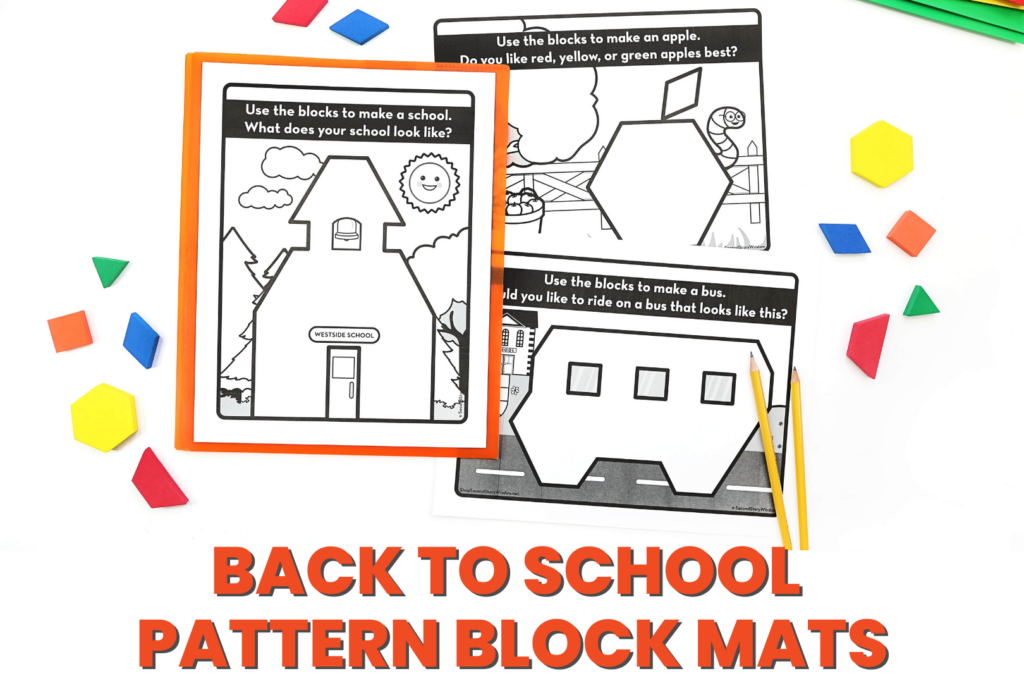
But if you want to give students a little more we do have a brand new back to school pattern blocks resource that you may want to grab. So we designed 12 Back to School themed pattern block mats. So you know there’s a school bus and a backpack and all that fun school stuff.
Heidi
And there are two versions of each mat so one is more open ended with kind of just a blank outline of the shape, so students can explore and try and see which shapes can fill the space. And then the other version has outlines of the shape blocks, so they can do some one to one matching.
Heidi
We included both so you can differentiate if you need to. But we used the open shapes with our preschoolers and they did great. So I think any of your elementary age students should be able to handle it fine.
Heidi
Plus, the more open ended the task, the more engaged they’ll be. And we do need to keep them busy for a few minutes so we can get this new school year underway.
Heidi
One thing I love about this set is that each of the mats has a get to know your question at the top. The questions relate to whatever the shape is. So for the pizza slice, the question is, what’s your favorite lunch?
Heidi
I thought that this might be a good way to help kids start to feel welcomed into the class. You know, if they can read, they can talk about the questions with their neighbors as they work. Or you know, as the teacher, you can maybe be walking around as the kids work, and it gives you a way to initiate a conversation with your new little students.
Heidi
I love that. This set also includes some pattern block prompts, like use the blocks to make the first letter of your name, or use the blocks to make your favorite animal. Again, this is a great way to start some get to know your discussions and an open ended task for them to work on.
Heidi
And we included some editable slides. If you want to project something for the kids to do, you can just add a welcome message and direct the kids to explore with the blocks until it’s time to get started.
Heidi
That’s a lot of information but don’t feel like you have to remember all of this. We also include in this little bundle a Teacher’s Guide to walk you through all of the whys and hows of using pattern blocks for your first day arrival activity.
Heidi
We would love to hear your tips for the first moments of the first day of school. Come share your thoughts over in the teacher approved Facebook group.
Heidi
Our second teacher approved tip today comes from Susan from the Shared Teaching podcast. Let’s take a listen.
Susan
Hello teacher approved listeners. My name is Susan and I am the host of the Shared Teaching podcast and the creator of Shared Teaching. First, I want to say thank you to Emily and Heidi for the opportunity to provide you with a teacher approved tip on one of my favorite topics: writing.
Susan
I personally think writing can be one of the hardest subjects to teach. For years, I’ve had to cobble together different resources and ideas to create my own writing curriculum. And I’m someone that enjoys not only teaching writing, but writing creatively, I can’t imagine how difficult it is for teachers who don’t love this subject, and who have also been given little to no training on how to teach it.
Susan
Many of my colleagues don’t enjoy writing. So I know if this is like you, you’re not alone. So where do you even start? One of the best ways to launch writing in your classroom is to use pre assessments much in the same way we would for reading or math. I love to use a writing pre assessment before I start any new writing unit.
Susan
Let’s say I am starting a narrative writing unit. Before any lessons or even information to students about what narrative writing is, I would provide all students with a blank piece of notebook paper if they’re upper elementary or a photocopy paper with lines and a box on the top for a picture if they’re lower elementary. Then I would give them a writing prompt.
Susan
If I want to teach primarily about personal narratives, then I would align my prompt to fit the genre. For example, I might give the prompt Tell me about your best day ever. I would then give students a chance to brainstorm. But if they are stuck, I might tell them besties can be big or small, with a family member or friend and are about a good memory, then I’ll let them write.
Susan
If I want to teach more about fictional narratives, then my prompt might be a baby elephant wakes up in a school late at night. Write a story about what happens. When students have finished their pre assessment, I’ll look them over and see if I notice any patterns. Maybe there is a lack of details or improper sentence structure. I am also looking to see if they wrote the correct style of genre.
Susan
Do they understand a narrative was a personal story about something from their life? Did they use words like I, me or my to tell about what happened on their best day. And looking at the fictional narrative prompt, I’m looking to see if they use story elements to tell their story.
Susan
Let’s move on to opinion writing. Before teaching an opinion writing unit, I will again pre-assess using an appropriate prompt. There are many prompts that you can find for free online, but not all of them will work. A good gauge is to think to yourself, if I was the one responding to this prompt, could I include all the parts of the writing genre I want from my students by the end of the unit? If the answer is no, then keep looking.
Susan
There are many different types of opinion writing so I’m not going to include a specific prompt for each one. Personally, I would only pre assess one type to see if students generally understand the components of an opinion piece before getting started. Opinion writing can be really fun and your prompt should be a little polarizing and get students thinking.
Susan
A classic example would be, should schools require uniforms? I bet a lot of your students have something to say about that topic.
Susan
Lastly, let’s look at an informative writing. When giving a pre assessment for informative or explanatory texts, my prompt might be write a text about like, the blank would be filled in with something I’m confident the majority of my students would know. This might be things that we’ve already studied, or something they’ve learned in the previous grade.
Susan
Some examples are write a text about males. Read a text about Rosa Parks and write about Roblox. The important things to remember about using reading pre assessments are to use a prompt that aligns with your expectations for the end of the unit and fits the genre. Use pre assessments before teaching or explaining anything specific about the genre you are assessing. And to not feel you need to grade the assessments thoroughly.
Susan
Simply looking them over and taking some notes about each student and finding patterns you notice about the majority of the class should be enough to get you started with what to teach.
Susan
If this tip was just what you needed, then I encourage you to get my free download a kindergarten through third grade writing skills progression chart. It breaks down exactly what to expect at the end of the year for each of these grade levels. Combined with the information from your writing pre assessment, you will be confident mapping out your lessons and knowing exactly what your students need to learn next.
Susan
You can find the download at sharedteaching.com/writing-skills-progression. Heidi and Emily, thank you again for having me on. And thank you for listening.
Heidi
Thank you, Susan for that fabulous tip. I think I speak for both of us when I say that we have both been in the camp of being overwhelmed by teaching writing every single year. You are so right that it’s not something that we get a lot of training in before becoming a teacher.
Heidi
It is such a good idea to start with a pre assessment before doing any writing units, especially at the beginning of the year. You want to get a good picture of where your student’s writing skills are at the start, so that you can use that information to plan your instruction. Plus, it will be great to compare that writing to another writing sample at the end of the year. Seeing growth is always so motivating.
Heidi
Thank you Susan for that wonderful tip and for the specific examples for prompts you could use depending on which genre you want to assess for. Be sure to check out Susan’s show the Shared Teaching podcast to learn more from her and grab your free writing skills progression chart for K-3.
Heidi
That’s it for today’s episode. Consider pattern blocks for your first day of school arrival activity. And remember Susan’s teacher approved tip to use pre writing assessments before launching your writing units.
More About Teacher Approved:
Do you ever feel like there’s just not enough time in the day to be the kind of teacher you really want to be? The Teacher Approved podcast is here to help you learn how to elevate what matters and simplify the rest. Join co-hosts Emily and Heidi of Second Story Window each week as they share research-based and teacher-approved strategies you can count on to make your teaching more efficient and effective than ever before.