
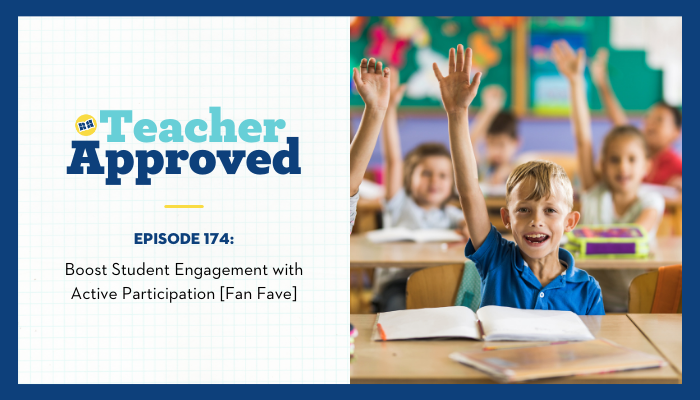
Click below to hear how to boost engagement with active participation:
Listen on Apple Podcasts | Listen on Spotify | Listen on Stitcher
Overview of episode 174:
These last two weeks of 2024, we wanted to replay our top two most listened to episodes. These are topics that resonate with our listeners and are considered fan favorites. So let’s start off with this episode replay all about ways to boost student engagement with active participation!
When creating lessons and activities, we’re always striving for them to be engaging and promote active participation in the classroom. However, academic engagement is just part of what makes a student engaged. They also need to be behaviorally and emotionally or mentally engaged, which means they’re active in all aspects of the classroom. So in this episode, we’re sharing ways to increase student engagement with 3 types of active participation strategies.
Each type of engagement strategy involves ways to increase active participation in the classroom from students. We know that student engagement is dependent on the balance between structure and novelty, which is why we provide examples that are fun for students, while still maintaining our expectations.
Engaged students participate in class discussions, are invested in peer relationships and are willing to meet your behavior expectations. So by focusing on the 3 types of engagement, you will have an increase in active participation in the classroom with your students.
Highlights from the episode:
[01:12] Today’s morning message: how do you manage students’ dry erase markers?
[7:04] Ways to increase student to teacher engagement.
[12:47] Tips for increasing students to content engagement.
[14:43] How to improve student to student engagement.
[17:26] Today’s teacher approved tip for giving your students a cue when you want them to respond out loud.
Resources:
- Jargon Journal Book Units
- Salt Lamp Nightlight
- Connect with us on Instagram @2ndstorywindow
- Shop our teacher-approved resources
- Join our Facebook group, Teacher Approved
If you enjoyed this episode, you’ll love these too:
- Episode 38, How to Survive December in the Classroom: 3 Creative Teaching Tips
- Episode 35, 5 Ways to Increase Student Engagement – Our Secret Weapon for Teachers
Read the transcript for episode 174, Boost Student Engagement with Active Participation [Fan Fave]:
Emily 0:04
Hey there. If I were to ask you what your biggest challenge is this time of year, I’m guessing one of the top challenges would be keeping your students engaged. It can be a real struggle.
Emily 0:16
This week, we’re revisiting one of our most popular episodes, all about how to add more active participation in your classroom to boost your students engagement, and this is extra important because more engagement often leads to better behavior. So give this episode a listen and make a plan for using these active participation strategies in your classroom in January.
Heidi 1:12
We start our episodes with a morning message, just like we used to do at morning meeting in our classrooms. This week’s morning message is, how do you manage students dry erase markers? And we have some helpful tips from our community.
Emily 1:25
Yeah, they had some really good ideas. So Kelly said, I have shared supplies at tables. I have spinning caddies that hold pencils, markers, big pink erasers and crayons. It takes some training for them to use them, right? But it works well. We have jobs at the end of the day, and one is supply supervisor who makes sure it’s nice and neat at the end of each day.
Heidi 1:45
I think using classroom jobs can help a lot with keeping things nice and neat in your classroom.
Emily 1:49
Yeah, and I did have caddies at my table sometimes, but I never put whiteboard markers in there. So it’s good to hear that idea. Rebecca said, I keep them in baskets in the front and hand them out as needed. Otherwise, they play with them and write all over everything. Yes, they do, which is why I was scared to do it at the tables. But it seems like you know, with training, you could maybe do that.
Emily 2:10
Michelle said, each student gets a whiteboard dry erase marker and a sock. I use small crew socks as erasers. They do double duty as a pen holder. I keep a tub of markers available as replacements. Karen said, I tell them that that’s the only one they’ll get until winter break. Right after they’ve written all over everything, their faces are priceless. Then I say, just kidding, and they breathe a sigh of relief. And then I follow up with you get two
Emily 2:37
April said, I keep them in a small tub and have students grab one when we need it. Then I let them draw for one minute before we get started. I tell them when the minute is up, you can show me your masterpiece, and then a race, or just a race, we always make sure we hear the click before we put it back in the bin.
Heidi 2:52
I think giving them that free draw time is so helpful. While everyone’s getting all their stuff out, keeps the messing around to a minimum.
Emily 2:59
And teaching them to listen for the click on the lids will make a big difference to how quickly your markers get dried out. Heather said, I got rid of dry erase and replace them with LED writing tablets, and my life has improved by 150%. I’ve heard those are pretty awesome. We’d love to have you join the conversation over in our teacher approved Facebook group.
Emily 3:21
Today, we are talking about one of our favorite topics, student engagement.
Heidi 3:26
Engagement is one of those things that you take for granted. You may not even notice you have it until it’s gone.
Emily 3:33
Yeah, and then it’s very obvious.
Heidi 3:36
That’s because student engagement is the glue in your classroom. All aspects of student learning and growth are held together by student engagement. If you don’t have it, nothing else will work.
Emily 3:48
Engagement is needed for any progress to happen. Kids who are engaged are more likely to excel in their learning. They have a more positive experience in school, and are set up for future success.
Heidi 4:00
Plus as a teacher, it is much more fun to teach engaged students than it is to teach checked out or misbehaving students.
Emily 4:08
For sure. What do we mean by student engagement? I was surprised to find that there is not one set definition for this.
Heidi 4:17
Yeah seems like the definition should be straightforward, because it is so clear when you’ve got engaged students, and it is so clear when you don’t.
Emily 4:24
Yeah, it’s so simple to tell when your students aren’t engaged, as I think we’ve all learned. So for our purposes today, we’re going to define engagement as the degree of students positive involvement and willing participation in what’s happening in class.
Heidi 4:39
When we talk about student engagement, we generally jump to academic engagement, but that’s only part of the picture. A truly engaged student is positively involved and willing to participate on a behavioral level and an emotional level as well as an academic level.
Emily 4:56
Engaged students are participating in class discussions, but. They’re also investing in peer relationships and are willing to meet your behavior expectations.
Heidi 5:05
I think all teachers want a class that participates like that. It makes our job so much easier. Yeah, so how do we get an engaged class?
Heidi 5:15
Student engagement is dependent on the balance between structure and novelty. Too much structure, and kids get bored. Poor kids are not engaged. They’re checked out. They’re causing problems and pestering their classmates, yay. They’re doing all of the things that give their poor teachers headaches.
Emily 5:34
But if we tip too far the other way and have too much novelty, then kids are overwhelmed and overwhelmed. Kids can’t learn, they can’t complete assignments, they aren’t any more engaged than the bored students.
Heidi 5:46
And they are also causing headaches, lot of headaches. So teaching, effective teaching means you’re always trying to balance structure and novelty in a way that keeps students engaged.
Heidi 5:58
If we’re getting a lot of glassy eyed stairs during a math lesson, we add in some novelty by letting them work on the assignment in small groups. But then, as is likely to happen if the kids are goofing around in groups instead of getting their assignment done, we pivot again, and we add more structure by turning it into a partner activity instead of a group activity.
Emily 6:18
We’ve talked a lot about structure recently, because you need so much structure to counteract the novelty of the start of the new school year. So today, we’re turning to the other side of the scale and sharing ways to add novelty. Specifically, we’re talking about how to add novelty by increasing active participation.
Heidi 6:38
We’ve got lots of fun suggestions that we’ve organized around three types of participation. The first type of participation is student to teacher engagement, this is how students participate in lessons. The second type of participation is student with content engagement. This is how students engage with the content they’re learning. And the third type of participation is student to student. This looks at how students collaborate with their classmates.
Emily 7:04
So let’s dive into how we can increase active participation with student to teacher engagement. A lot of this comes down to how you ask your students questions and how they respond.
Heidi 7:14
The traditional way of asking questions really shuts down student participation. The teacher says, Oliver, tell us the capital of Missouri. Suddenly, Oliver is the only one who needs to think about the capital of Missouri.
Emily 7:27
It might be easy to overlook, but thinking is actually active participation. It’s covert active participation, because you as the teacher can’t tell if it’s happening, but it is still an active process. And when the teacher starts a question by choosing the person to respond, Oliver is now the only one participating in the thinking, and 23 other kids know they have the freedom to daydream.
Heidi 7:51
So asking the question, first giving think time, and then choosing a student at random increases the likelihood that everyone is engaging with the question.
Emily 8:02
That means the kids know to be prepared with an answer in case they’re called on. But there are lots of other ways to get student responses besides just calling on a student.
Heidi 8:12
Having everyone write an answer on a whiteboard is a classic for a reason. Can’t go wrong with that. And then you have the students hold up their answers. And if you want some tips for managing whiteboards and markers, go back to that morning message we just shared at the top of the episode.
Emily 8:25
I like using whiteboards in my lessons, because then I can easily see who understands the content and who needs some extra support.
Heidi 8:33
Another way to do that is to give students an action to do. You can say something like touch your nose when you know the answer, or if you can tell me who the main character is, stick out your tongue, you can’t tell students are thinking of a correct response the way you can with a whiteboard, but it’s easy to see who understands quickly and maybe who is struggling.
Emily 8:52
Plus, adding an action is a fun way to sprinkle some novelty into your lesson without things getting too crazy.
Heidi 8:58
In our jargon journal vocabulary lessons, we use a prompt called fist to five. When a new vocabulary word is displayed, students are supposed to rate their familiarity with it. If they hold up a fist, they’re signaling that they have never heard the word before, so zero fingers. If they hold up all five fingers, they’re signaling that they know a lot about the word and could explain it to someone else.
Emily 9:22
And students might hold up different numbers of fingers to rate their familiarity with the word. If they recognize a word, students might hold up one or two fingers. If students know a lot about a word, they would hold up four or five fingers. I love this activity
Heidi 9:35
I love this activity because it’s such a good way to get kids thinking about their understanding.
Emily 9:41
And it’s helpful for me as a teacher to get a sense of how comfortable students are with the content before we dig into it.
Heidi 9:46
If you want a robust vocabulary program that makes use of lots of active participation, check out our jargon journal book units. We have several units that use fun picture books to teach. Each vocabulary in engaging, interactive ways, and we’ll be sure to link to that in our show notes.
Emily 10:04
So fist to five works great for vocabulary words, but you could use it for any content. For example, in math, you could show a geometric shape and ask students to rate from fist to five how much they know about it.
Heidi 10:17
Going back to our jargon journal lessons, they also incorporate signals as part of a review activity. We display one of our vocabulary words at the end of the week and give four numbered definitions, then students hold up the number of fingers that correspond to the correct answer.
Emily 10:33
And this format works for any content too. Just display a question along with numbered multiple choice answers.
Heidi 10:40
Ask your students to hold up the number of fingers that correspond to the correct answer. Just make sure that you coach your students to hold their hands right in front of their chests. If students are putting their hands up in the air, your less certain students are going to copy your more confident students.
Heidi 10:57
And while that’s not going to impact anyone’s grade, if the purpose of this activity is for you to pinpoint holes in your students understanding, kind of need to know where those holes are.
Emily 11:07
I also like to use a signal to let kids show me they’re ready. I would say something like, after you put your name on your paper, hold up your pencil, that shows me you’re ready to go on, giving kids a task to do while they wait helps keep them from checking out.
Heidi 11:20
There’s also the classic thumbs up, thumbs down. Give me a thumbs up if snow is a form of precipitation, or a thumbs down if it’s not. But you could easily do the same thing with larger actions.
Emily 11:31
If you want to give your kids a chance to move, stand up if pancake is a verb, crouch down if it’s not a verb. You could really add some fun this way, turn in a circle if the answer is yes, curl up in a ball. If the answer is no.
Heidi 11:43
We love sprinkling in some surprise and delight with a signal. If you’re worried about kids getting out of control with the silliness of a fun signal, spend most of the activity with just the basic thumbs up, thumbs down, and save the silly movements for maybe the last question or two.
Emily 11:58
If you have the technology, a Kahoot or near productivity is ideal for this type of response, because you can see exactly how each student answers.
Heidi 12:10
Technology can also be a great resource for promoting student with content engagement. Depending on the age of your students and the technology you have available, students could be using devices to research interact with or respond to the content.
Heidi 12:15
But there are lots of analog ways to get students to interact with the content. A good quick write is always a handy activity.
Heidi 12:31
And quick writes are nice because really, all you need is a paper and a pencil. You give students a prompt like write down everything you know about goods and services, and then you just give them two to three minutes to respond. And honestly, if you teach the low grades, two minutes might be too long.
Emily 12:47
You can start a lesson with a quick write to get the students thinking, or end a lesson with a quick write to see what they’ve learned.
Heidi 12:53
Exit tickets are another engaging way to end a lesson. They help students interact with the content and help the teachers see how well students understood the material.
Emily 13:03
Activities that incorporate movement are a great way to keep students engaged in their learning. You could set up a scoot activity where students shift from desk to desk to answer questions.
Heidi 13:13
Scoot is fun, but it can be a headache to manage if you don’t lay out the movement process very clearly. I like posting questions around the room instead and just letting these students walk around and answer them. That kind of helps cut down on traffic jams and confusion.
Emily 13:28
Yeah, and everyone can move at their own pace when you do it that way. Or instead of posting questions, you can post answers or statements in your classroom corners and do a four corners activity. You read a question, and the students move to stand in the corner that they think answers the question.
Heidi 13:44
Four corners is especially fun if the responses allow for some discussion, maybe a question like, Why do you think that insensitive is a good trait to describe this character? And then the kids at each corner can discuss their ideas before sharing with the whole class.
Emily 14:00
An even simpler way to incorporate movement with your content is to have kids move to different sides of the room. Tell students to stand on one side of the room for one answer and the other side of the room for a different answer. The nice thing about the sides of the room activity is that it doesn’t require any prep. If you can see your classes a little checked out, this is an easy way to incorporate that novelty on the fly.
Heidi 14:21
Another no prep way to boost student engagement with the content is to change up the tools that they use to complete an assignment. So maybe you let them use markers or pens for their spelling practice, or have them solve a math problem on a sticky note. That’ll feel like a win for kids. The novelty of a new tool is a great way to boost student engagement.
Emily 14:43
So we’ve covered student to teacher engagement and student to content engagement, and now we’ve got our last type, which is student to student engagement. The simplest way to incorporate this type of engagement is the classic turn and talk. You give students a question and then have them turn and talk to a neighbor about their responses.
Heidi 15:01
You definitely have to train students how to do student to student activities before you use them in a lesson, or you will have chaos. But the learning that comes from these type of activities is worth the time and effort it takes to teach students how to work together.
Emily 15:19
Thanks to professional development we’re all probably familiar with the jigsaw activity. Oh, the jigsaw where you switch tables for different discussions, but there are so many different interactive learning structures that not only increase student engagement, but also boost their understanding.
Heidi 15:35
With my second graders, I like to do a mingle. I don’t know where I got this idea from. I didn’t make it up, but so I would pose a question, and then I give them a few seconds of think time, because they’ll respond with better answers if they think first. And then I told my students to stand up and walk around the room while I said, mingle, mingle, mingle, or maybe I played a song, and when I stopped, they kind of had to extend one leg so they were standing toe to toe with the first person they encountered.
Heidi 16:00
And the key here is that you don’t let them wait around to partner with their friends, or this whole thing falls apart. They just have to buddy up with whoever they’re closest to. When everyone is partnered, the kids would share their responses with each other, and then I might ask another question and have them mingle again. Or maybe I would keep the same question and have them continue the discussion with a new partner.
Emily 16:21
If you want more examples of interactive learning structures that get students thinking and engaging with each other, search for Kagan, and that’s K, A, G, A, N, interactive learning, and you will find lots of fun ideas.
Heidi 16:35
Yeah, Kagan’s like the king of the interactive learning styles. But besides interactive learning, you can boost student to student engagement with group work or projects or our favorite learning games.
Emily 16:46
I love to use games with my students because it’s so motivating for them and a fun way to help them master important content.
Heidi 16:53
Finding ways to boost your students engagement is important because student engagement is the glue that just holds your classroom together, plus engaged students are much more fun to teach than disengaged students. So in the long run, boosting student engagement really benefits everyone.
Emily 17:11
And we hope you will try out some of these ideas for student to teacher engagement, student to content engagement and student to student engagement. And we would love to hear your thoughts about boosting student engagement over in our teacher approved Facebook group.
Emily 17:26
Now let’s talk about this week’s teacher approved tip. Each week we leave you with a small, actionable tip that you can apply in your classroom. Today, this week’s teacher approved tip is give students a cue when you want them to respond out loud. Tell us more about this tip Heidi.
Heidi 17:41
So one way to increase student engagement is to have them corally respond to a question. Anytime the response to a question is going to be a short and straightforward answer. Asking for a choral response is nice because it means every student has to give an answer, or, you know, most of the students, I guess. But we also don’t want to train students that we accept blurted out answers.
Heidi 17:41
So the way to avoid that is to create a cue you can use when you want a choral response, so it’s clear to students that this is the moment they are allowed to respond out loud. To do this, you’ll need something like a signal and a verbal cue. Maybe your signal is holding your hand up and your cue is saying everyone while you cup your ear.
Heidi 18:27
So that might sound like this. In a moment, I’m going to ask everyone to respond, but for now, I just want you to think about the answer while my hand is in the air. You should be thinking how many syllables are in the word watermelon, so you hold up your hand in the air for a few seconds, and then you cup your ear and say, everyone, and the class responds, Four.
Emily 18:48
The nice thing about this is that if students do blur it out, it’s easy to gently correct them. You can say something like, Oops, I heard someone answer, but my hand was still in the air. Let’s try it again this time, wait until my hand is by my ear and I say everyone by having a structure you can remind them of you’re solving the problem without making your students the problem.
Heidi 19:07
If you have a choral response cue, please come share it in our Facebook group. We would love to hear your ideas.
Heidi 19:15
To wrap up the show, we’re sharing what we’re giving extra credit to this week. Emily, what gets your extra credit?
Emily 19:21
I’m giving extra credit to salt lamp night lights. So one of my favorite Instagram follows is John and Sherry at young house love, which is funny, because I don’t DIY at all, but I just like them as people. So last year, Sherry shared these salt lamp Night Lights she had gotten for around the house and just to add some extra light in the dim hours. So I got one for my kitchen backsplash just to try out. And I love it.
Emily 19:47
Especially now that it is getting quicker, earlier and earlier, against my express wishes, that it stay light until 9pm all year round. Still mad about that same I think I’m gonna try. Adding some more of these night lights around my main living area, though, because it’s a really warm, soft glow that boosts the feeling in the room and the light. I just don’t know how to explain it, you guys, you just have to get one if you have a spot you want a little extra light as we head into the most terrible winter. I hate winter so much. Give these a try.
Heidi 20:20
They could also be nice in your classroom too, just to add a little glow.
Emily 20:23
I know I love it. That’s a good idea. Try it in your classroom and tell us what you think. What are you giving extra credit to Heidi?
Heidi 20:29
My extra credit goes to the return of one of my favorite podcasts called the dream. And this season, they are diving into the good and the bad of the coaching industry talking about like wellness coaches and life coaches and business coaches and all the other coaches you can hire. I have loved every season of the dream.
Heidi 20:49
The first season was probably my favorite, and it was all about the history of MLMs, oh yeah, and it was jaw dropping, to put it mildly. The second season dove into the wellness industry, and now this third season is tying them both together with a look at coaching. And don’t panic. If you’re someone who really likes coaching, I feel like they do a fair job of calling out what’s predatory in the coaching industry, because you know that that happens without ignoring the benefits that it can have. It’s just kind of wild.
Heidi 21:19
So after you listen to our episode each week. Yes, that’s the caveat. You have to listen to ours first. You might want to check out the dream.
Heidi 21:27
That’s it for today’s episode. Try our ideas for adding more active participation in your classroom, and don’t forget our teacher approved tip to give students a cue when you want them to respond out loud.
More About Teacher Approved:
Do you ever feel like there’s just not enough time in the day to be the kind of teacher you really want to be? The Teacher Approved podcast is here to help you learn how to elevate what matters and simplify the rest. Join co-hosts Emily and Heidi of Second Story Window each week as they share research-based and teacher-approved strategies you can count on to make your teaching more efficient and effective than ever before.