
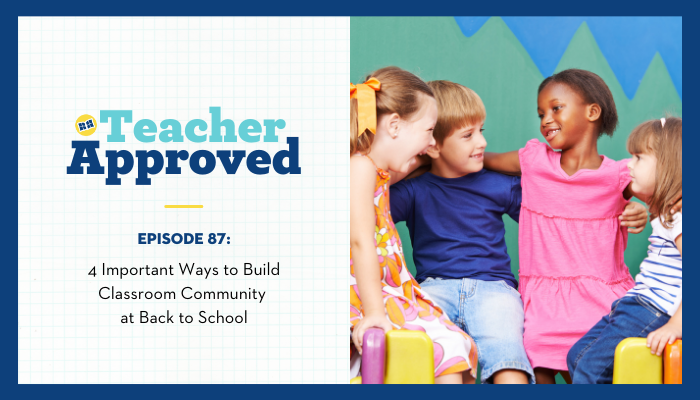
Click below to hear back to school classroom community tips:
Listen on Apple Podcasts | Listen on Spotify | Listen on Stitcher
Overview of episode 87:
At the beginning of the year, it’s tempting to want to jump right into academics with math centers and literacy groups. And while we find academics important, we believe building relationships with your students takes precedence. In fact, having that community is what keeps students engaged in your lessons and improves student academics. We’re sharing our 4 back to school classroom community tips with you today!
A major component for building a classroom community starts with affirming students at the beginning of the year. We discuss ways to make students feel seen and valued in your classroom, along with how to establish a teamwork mentality amongst their peers. Each of the four back to school classroom community tips need to be intentional in your room in order to make the positive impact it can have.
We challenge you to spend time at the start of this school year to create a positive classroom culture. With tips for our teacher approved community, along with suggestions from our own personal experiences, we’re providing activities for establishing back to school classroom community this year. Remember, this does take time, but it’s never wasted time!
Highlights from the episode:
[00:48] Today’s morning message: what do you do when you get your class list?
[6:06] How to recognize students as individuals.
[9:14] Ways to build a positive class identity.
[12:41] Tips for making connections among class members.
[14:15] How to extend community outside the classroom.
[15:50] Today’s teacher approved tip for making a student work display board.
Resources:
- Daily Morning Messages Bundle – 2nd Grade
- Sturdy Paper clips
- Connect with us on Instagram @2ndstorywindow
- Shop our teacher-approved resources
- Join our Facebook group, Teacher Approved
If you enjoyed this episode, you’ll love these too:
- Episode 73, 4 Reasons Why Affirming Students is the Most Important Goal for Back to School
- Episode 28, How to Launch Morning Meeting
- Episode 6, Morning Meeting: An Essential Routine
Read the transcript for episode 87, 4 Important Ways to Build Classroom Community at Back to School:
Emily
Hey there, thanks for joining us today. In today’s episode, we’re sharing four ways to build your classroom community, and a teacher approved tip for displaying student work.
Heidi
We start our episodes with a morning message just like we used to do at morning meeting in our classrooms. This week’s morning message is what do you do when you get your class lists? Emily kick us off.
Emily
Definitely start labeling things. That is my favorite thing to do. The thing I’m most anxious to do, because I have so much labeling to do. But it can be risky to start right away to be sure. But at my school, we got our lists late enough that it was usually pretty safe.
Emily
If anything, you might be adding students usually adding the names, which is why I never did the numbering because it would mess up the whole numbering system. But the things can be labeled by name and then you can add more kids and that works okay. How about you, Heidi?
Heidi
The very first thing I did, maybe I should be embarrassed to admit, is scan the list for any names I might know. Because if I already knew a kid’s name that usually wasn’t a good sign.
Emily
Or it could be a younger sibling.
Heidi
Which could be a blessing. Less of one depending on the family.
Emily
Yeah. We have some responses from our community. Jennifer said panic. Jennifer. Lauren said make a parent email group, label folders and make name tags and make class checkoff list for grading and assignments.
Heidi
She’s got a system
Emily
Yeah. April said count and then check out the boy to girl ratio.
Heidi
Oh that’s, if you’re not a teacher, you don’t know how important that is.
Emily
Yes. Tina said I label everything. Determine how they will be in the cubbies and make sure their meet the teacher paperwork is ready, we get our list the day of open house. That’s rough.
Emily
Donna said send out Welcome to my class letters and supply lists. And Robin said, wait for it to change as it will. We’d love to have you join the conversation over in our teacher approved Facebook group.
Heidi
For me, one of my favorite parts of being a teacher is taking a group of little strangers at the start of the year, and working with them to create a positive classroom community by the end of the year.
Emily
Coming together as a connected group over the course of the year is really the magic of having a classroom.
Heidi
A few weeks ago, we talked about our ATTABOY back to school goals. ATTABOY stands for affirming, training, teaching and assessing, the ATTA there at the beginning of the year. There’s your boy. In episode 73, we explained why affirming is the most important of those goals.
Emily
So affirming students at the beginning of the year means intentionally creating a peaceful classroom that safe and welcoming to students. It’s looking for opportunities to give students ownership and choice.
Heidi
Affirming also means striving to recognize each student as a unique individual who contributes to our classroom in valuable ways. And of course, it’s also providing time for fun and community building activities.
Emily
It’s so easy to feel like you need to jump right into academics at the start of the school year. Right? You have math units to start. You need to teach the writing process and assess your students reading fluency.
Emily
But spending time affirming your students at the beginning of the year makes all of the math and writing and reading and everything else you need to cover much more effective.
Heidi
It can be hard to remember when you feel so much pressure. But affirming matters because it’s how we build relationships with each other. It allows us to create a classroom space where students feel accepted and included.
Emily
That may seem minor, but it’s actually vital to your student success. When students feel accepted and included it increases their engagement and increased engagement leads to improved academic outcomes and reduce behavior problems.
Heidi
So increased learning and decreased misbehavior is a win for everyone.
Emily
It isn’t that what every teacher wants?
Heidi
So really, the only downside to affirming is that you will have to be intentional about including it. It won’t just happen on its own.
Emily
So today we’re going to share ways that you can affirm students not just at the beginning of the year but all year long.
Heidi
To start with it might help to think of your classroom community as a quilt or a puzzle. One piece by itself doesn’t do very much. However, the whole group is incomplete if even one of the pieces is missing. The quality of the whole depends on how well the pieces fit together.
Emily
For that reason, you’ll sometimes see Back to School activities where every student decorates a puzzle piece or quilt piece. And it’s assembled and hung on the wall as a way of showing how we combined to make something bigger than ourselves.
Heidi
That activity is a classic for a reason. So keep that image of a puzzle or quilt in your mind as we share some ideas for building your class community.
Emily
And because we love the list there this there are four areas we’re going to focus on. So in no particular order. The four ways to build class community are recognizing our students as individuals, building a positive class identity, making connections among class members and extending our community outside the classroom. Why don’t you tell us more about how we can recognize our students as individuals, Heidi.
Heidi
I would love to. So back in episode 73, we mentioned that student names should be visible somewhere in the classroom. Even if you use student numbers of labels, there should be named somewhere at the very least, they should be on the door so that your students know that they are in the spot that is meant for them.
Heidi
But there’s a lot more that can be done with names. Obviously, you can do the class puzzle or quilt activity. I’ve seen a lot of teachers like print off their student names in big bubble letters, and then they let the kids decorate them as a first art project.
Emily
Oh, I love that. In our teacher approved Facebook group April shared a great way for helping students get to know each other’s names.
Emily
She says, the first few weeks I do a king and queen of the day, where I slowly pull out a name written on a sentence strip from an envelope and say things like this person’s name starts with a letter near the beginning of the alphabet. It makes a long vowel sound. And I give clues like that. We go over each letter and it sound as it’s pulled out. Then when we finally go over the last letter, and everyone is up to speed on who it is, I have the king or queen come stand by me.
Emily
I put a paper crown on their head. I asked them a few questions and let the kids ask a few questions. Then we talk about how many syllables in their name, point out any features like Schwaz, double consonants, vowel teams, etc. Then everyone gets a half sheet of paper and we write the king or queens name on the bottom of the sheet: vowels in red consonants in black.
Emily
They draw a picture of the person and sign their own name on the back. As they finish. I gathered them and staple them together with a king of the day or queen of the day half sheet of paper, and they take it home that day. We do this every day until we run out of students.
Heidi
I love that idea. It incorporates so many important things. She’s teaching students how to use and respect each other’s names. She’s recognizing each student individually and helping the class get to know them. And she’s adding in some great phonics work.
Emily
Yeah, it’s such a good idea. But if your students are too old to enjoy being king or queen of the day, a student spotlight is a great alternative. You could spotlight one student a day or stretch it out over the school year with a student of the week.
Heidi
Maybe you could allow the student of the day or your student of the week to bring a show and tell to share with the class and then ask them some questions so everyone can get to know them better.
Emily
I know a lot of teachers have students bring a poster to share. But just a suggestion to maybe consider finding a way to recognize your students without giving the parents something they have to do. This doesn’t come from personal feelings or experience at all. No, definitely not.
Heidi
Student of the day or student of the week is definitely an investment of time, particularly if you have a large class. But think of how great each kid feels when they get their chance to be recognized.
Emily
Yeah, building classroom community does take time, but it’s never wasted time.
Heidi
It’s more like an investment in developing the best versions of your students.
Emily
And remember, community building doesn’t happen unless we’re intentional about making it happen. So besides recognizing our students as individuals, what else can we do to build classroom community Heidi?
Heidi
Well, we can work on building a positive class identity. That is actually one of my favorite things to do as a teacher.
Emily
There are probably so many ways you’re already building a positive class identity. When you set high expectations for students and hold them accountable for meeting them, you’re building class identity.
Heidi
And along with that, explicitly teaching your procedures and expectations does a lot for shaping your class identity, as does celebrating mistakes and fostering a growth mindset culture.
Emily
Those are some of the big ways that your class identity is shaped but there are lots of little ways to contribute to a positive culture. You can make it a priority to greet students in the morning. You can set up a teacher mailbox so students can write to you.
Heidi
If you’re brave, you could even have a class pet.
Emily
And if you’re like us and you are not that brave, you can have a class mascot instead.
Heidi
Yeah, that’s much more my speed. I did have a class book fairy for one year, which was super fun. Yes, but my favorite way to shape class identity is through morning meeting. Love morning meeting.
Emily
Morning meeting has such a big impact on the culture of a classroom. And episode 28 of the podcast, we shared everything you need to know about launching morning meeting. That’s a must listen, if you need help launching it for the first time, or you just want to make sure you’re getting it off on the right foot this year.
Heidi
If you take nothing away from this episode, its do morning meeting.
Emily
We promise that the thing that will build your classroom community more than anything.
Heidi
But really any activity that brings students together is also building your class identity. And one of the best shared activities is a read aloud.
Emily
I love read alouds there’s something almost magical about gathering everyone in for a storytime. I read to my students multiple times every day.
Heidi
Oh, I did too. I couldn’t get enough of reading my kids. I do that all day if I could. Any book that lends itself to a meaningful discussion will help build your class community.
Heidi
But some great ones for back to school are Our Class is a Family by Shannon Olson, several teachers in our Facebook group recommended that one. And that same author also wrote A Letter From Your Teacher On the First Day of School.
Emily
I love both of those books. Of course, there’s the classic First Day Jitters too. And Linnea tab has a fun pair of books, you’re meant to read a teacher’s top secret, confidential at the beginning of the year, and a teacher’s top secret mission accomplished at the end of the year. And they both have a great message about how special the kids in your class are.
Heidi
There are so many more fun back to school books these days, than when I started teaching, I know it’s kind of a shame that you can’t stretch back to school books all year long.
Emily
You have to pack in as many as you can in those first few days because they’re so good. And remind yourself that you’re helping kids develop a love of reading and building classroom community by spending lots of time reading those books.
Heidi
So really, you’re kind of obligated to read them all.
Emily
Mm hmm. It’s true. Besides reading all the books, what else can we do to build a positive class identity?
Heidi
Several teachers in our Facebook group mentioned that they use STEM activities to build community. Angie said that she particularly liked the activity Saving Sam, which involves a gummy worm.
Emily
And I wasn’t familiar with this. So I watched a video about it. The kids work as groups to rescue a gummy worm. It looks like a lot of fun and I can definitely see how it would build a positive feeling in the classroom.
Heidi
And having kids work together is a great way to meet our next suggestion of making connections among class members. We want kids to see their classmates as their teammates, and solving problems together like saving a gummy worm is a great way to do that.
Emily
The beginning of the year lends itself to get to know you activities. A fun one that gets kids up and moving is find someone who it’s like a mini scavenger hunt. Find someone who has a pet, find someone who likes to swim, find someone who likes a food that you like. It’s a great way for kids to start making connections with their classmates.
Heidi
And hopefully they’ll find out that they have more in common than they thought.
Emily
Your seating arrangement can also go a long way toward helping students make connections. Even if you move the kids to rows in a few weeks, starting the year with your desks in arrange tables, sends the message that we value teamwork here.
Heidi
And of course, the very best way to build connections among people is to play and laugh together. Look for opportunities to have fun as a class. You can even make it part of your daily routine. Jeff from our community said that he starts off the school day by sharing a Laffy Taffy joke.
Emily
You can’t go wrong with a cheesy joke. And we like to laugh and connect with our students every day with our daily morning messages, which we use as part of our morning meetings. And we’ll link to those slides in the show notes.
Heidi
Okay, so we are recognizing individual students, building a positive class identity, helping make connections among class members. Emily, what’s the fourth way we can build class community?
Emily
We can do that by extending our class’s impact outside of our classroom. That might look like having your class write thank you notes to a school helper, or bringing in the soccer balls that have been abandoned on the playground.
Heidi
You can look for all of the little ways that your students can make an impact. Or maybe you want to implement a dedicated kindness program, or raise awareness of an important cause.
Emily
Working as a class to provide service is one of the most powerful ways to build relationships. This does require more planning and forethought than most of the suggestions we’ve made in this episode. It’s okay if that feels too far outside of what you can handle right now. Take what works for you here and leave the rest.
Heidi
But even if you don’t feel like you couldn’t take that on, I would recommend maybe tucking this suggestion into your back pocket as a just in case. If you have got a tricky class, maybe a class that argues a lot or is very cliquish, providing them with a meaningful way to make an impact might be the answer you need.
Emily
Yeah, it’s definitely easier to plan a service opportunity than it is to referee kids fighting all day.
Heidi
Having a positive classroom community won’t solve all of your teacher headaches, but it is a huge step in the right direction.
Emily
So as you’re launching this new school year, look for ways to recognize your students as individuals, build a positive class identity, make connections among students and extend your class outside your room.
Heidi
We would love to hear your thoughts on how you build classroom community. Come join the conversation in our teacher approved Facebook group.
Emily
Now let’s talk about this week’s teacher approved tip. Each week, we leave you with a small actionable tip that you can apply in your classroom today. This week’s teacher approved tip is make a student work display board. Heidi, tell us about this.
Heidi
So as is common in a lot of schools, Emily and I both taught in schools, where examples of student work were meant to be put on display. The first few years I taught I would spend 20 or 30 minutes after school every few weeks, taking down projects and taping up new ones. The task got a little faster when we got those like cork strips along the wall that allowed me to use tax instead of tape. But it was still a time set. And then Emily, you came up with a way to one and done it.
Emily
Oh that’s right. I had a huge bulletin board in my classroom that I wasn’t sure what to do with and honestly, I hate making bulletin boards, and I hate changing them out. It’s just such a hassle. So I dedicated that space to a student work display, where they could display any work that they were super proud of.
Emily
So early in the school year, I took a photo of each student that I put on a big piece of black cardstock. You could also have them draw a self portrait to attach instead of a photo whichever you prefer. Then I added a name tag and laminated it. I found some giant paper clips like four inch heavy duty paper clips, I think at target that I attached to each one so students could slip their own work in and out whenever they had work they wanted to display. I’ve also seen this done with clothespins, too.
Heidi
We’ll link to the paper clips in the show notes so you can see what we mean. I liked using the paper clips instead of closed pins because close pins are really easy for kids to break. And when a close pin is glued to a picture, it is tricky to switch out.
Heidi
Yeah, I did have to really like tape down my paper clips on the back of the cardstock like a ton of tape, a heavy duty masking tape or duct tape. Because otherwise they tended to disappear. But the tape was enough of a deterrent, that I really think I only lost two in all of the years that I used them.
Emily
But yeah, that’s the great thing, you can just reuse these paper clips every year. It does take a little setup. But I really liked this because it cut down on wasted time for me. But also because it was a way to actually celebrate my individual students.
Emily
When I chose what went on display, I was telling the kids what they should be proud of. When the kids chose what to display, they were celebrating what they were really proud of. And sometimes it surprised me what they picked. If they didn’t have anything they wanted to display, they still had their self portrait representing them as part of our class community.
Heidi
And I really loved this idea so I made it work in my own class. I didn’t have the same wall space in my room. So I put the kids self portraits out in the hall, I did have to set the expectation that kids could only put one thing at a time because otherwise they were just like everything, every paper they made ended up on display. But once we set that rule, it worked okay.
Heidi
I will say though it does look a little hodgepodge having lots of different kinds of work on display. Using the black cardstock helps tone it down a little bit and kind of ties it all together. But it is not the uniform look that you might be used to. And if your school is big on impressing parents with what goes in the hall, this might not work for you.
Emily
I hope that that’s not true for you though, because really it doesn’t really matter. It’s so does that. But if you want a way to make your hallway display more meaningful and less work to update, this might be your answer.
Heidi
To wrap up the show we are sharing what we’re giving extra credit to this week. Emily what gets you extra credit?
Emily
I’m giving extra credit to the book When in Rome by Sarah Adams. It’s a modern rom com take on the classic Audrey Hepburn movie Roman Holiday. The story is about Popstar Amelia Rose who decided she needs a break from her demanding life and runs away to Rome, Kentucky.
Emily
But of course her car breaks down outside the home of brokenhearted pie shop owner Noah. A brokenhearted pie shop owner I know. You can imagine how it goes after that. It’s the perfect fluffy rom com read and there’s a second book out in this series too called Practice Makes Perfect, which I also enjoyed.
Heidi
I love Roman Holiday so I need to check that out.
Emily
What are you giving extra credit to Heidi?
Heidi
So my extra credit goes to Morgan Harper Nichols. I know I’ve mentioned her before, but I get the best encouragement from her poems and writings.
Heidi
There was a bit in her newsletter this week that seemed perfect for teachers in August. This time of year, you know how it goes. It’s just so easy to get lost in the to do list and the worries. But don’t forget to make room for all the good that lies ahead, too.
Heidi
And if you are already back in the classroom, if you’re heading back soon, or if you still have a few weeks ago, consider this a little pep talk from Morgan and also for me.
Heidi
So she writes words for August. As you prepare your heart for all possible outcomes. Remember to prepare your heart for positive outcomes too. Prepare yourself for good memories, good lessons, and all the little places where sunlight will come shining through.
Emily
Oh, I love that.
Heidi
So that was a good reminder that this is so hard, but there’s also so much amazing that comes with it.
Heidi
That’s it for today’s episode. Remember our four ways to build classroom community and don’t forget our teacher approved tip to create a student work display.
More About Teacher Approved:
Do you ever feel like there’s just not enough time in the day to be the kind of teacher you really want to be? The Teacher Approved podcast is here to help you learn how to elevate what matters and simplify the rest. Join co-hosts Emily and Heidi of Second Story Window each week as they share research-based and teacher-approved strategies you can count on to make your teaching more efficient and effective than ever before.